

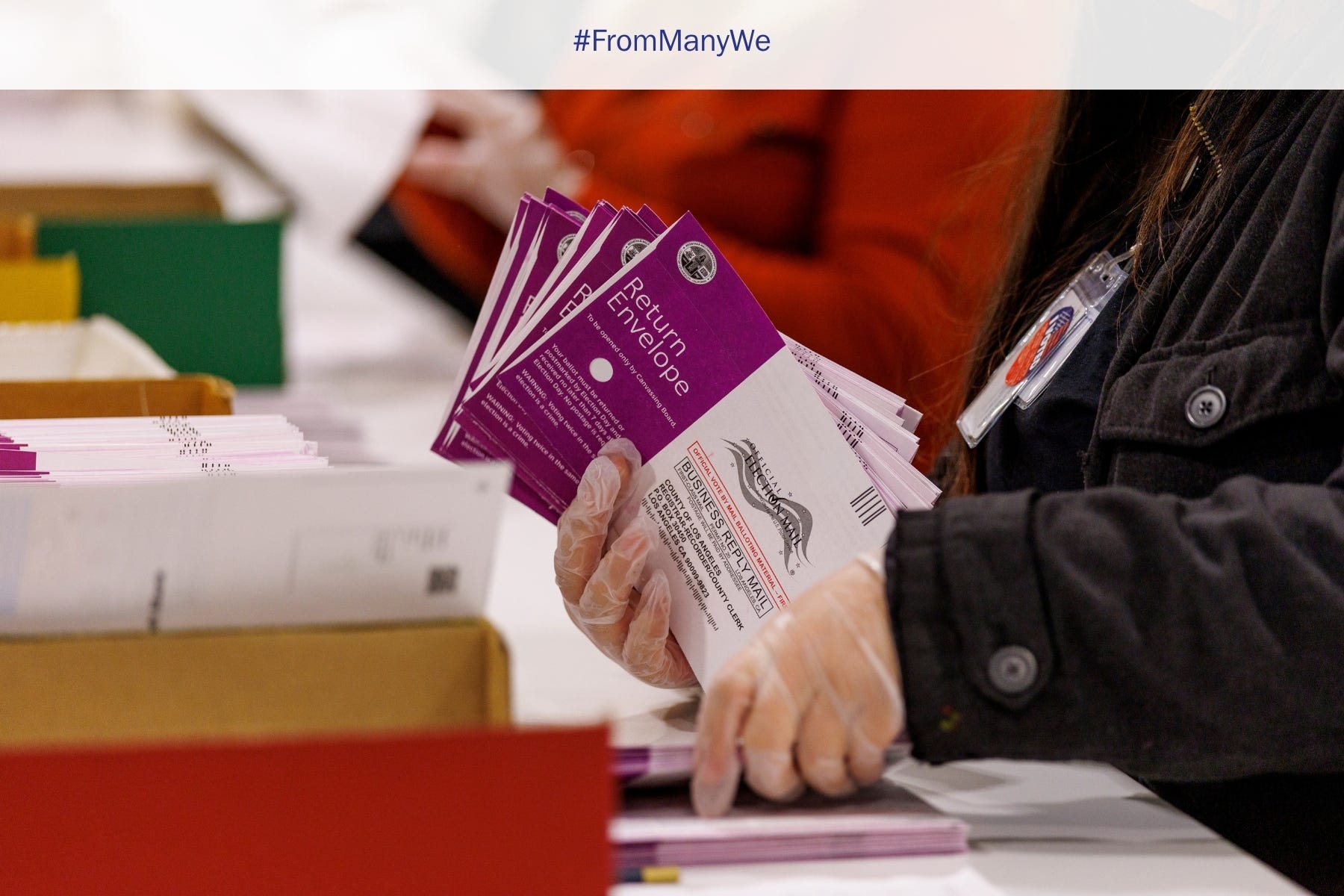
Observers are bracing for the 2026 midterm elections—not only in anticipation of the outcome, but also out of concern for the integrity of the process. Risks come from many directions: federal agents at polling places, cyberattacks, rogue counties refusing to certify, attacks on mail-in voting, organized efforts to delegitimize the outcome, or any number of other possibilities. According to polling by the Kettering-Gallup Democracy for All Project, 57% of survey respondents are worried about ballots not being properly handled, and more than two-thirds fear political leaders will pressure officials to change election outcomes.
Then there are the risks that make fewer headlines. In a forthcoming report, produced with All Voting is Local, based on interviews with election officials, I describe the long tail of consequences from recent federal actions including layoffs at the Cybersecurity and Infrastructure Security Agency (CISA) and the firing of several members of the Election Assistance Commission, which sets standards for voting equipment. While election officials told me they feel ready and supported going into 2026, the longer the drought in federal support continues, the more likely something is to eventually break.
Many of the short-term threats are not new and may not be catastrophic, while the long-term threats may play out over a long enough time that they will escape public notice. And both overlap with a third threat: the increasingly polarized nature of the public’s trust in elections, which is likely to make these challenges more difficult to solve.
Voter Intimidation and Deployment of Federal Agents
One of the most frequently cited risks to the midterms is the possibility that the administration will station federal agents—especially from Immigration and Customs Enforcement (ICE)—at polling places for the purposes of deterring voters. After all, ICE has not limited itself to only detaining noncitizens. Fear is a reasonable response to its presence.
The Department of Homeland Security denies that it has any such plans, but members of the administration have been somewhat cagier in responses when asked. Legal analysts say that federal law prohibits officials from stationing military or other federal agents at polling places. All 50 states have laws against voter intimidation, and several prominent advocacy organizations have filed a lawsuit to prevent DHS from stationing agents at polling places.
The law may be a thin shield under authoritarianism, but there are also practical obstacles to a nationwide surge of federal troops or agents: there are simply too many polling places. Agents would have to concentrate on a sufficient number of strategically important locations, and even that might stretch their numbers thin. What’s more, elections take longer than they used to; early voting has already begun in many states. Even if the administration targeted swing districts with above-average immigrant populations, a nationwide surge would be logistically challenging.
There is another source of personnel available to the government: the National Guard and the US military. The president could conceivably declare a national emergency, attempt to federalize the National Guard, and deploy soldiers to polling places for the purpose of intimidating voters, seizing voting equipment, or for the purposes of propaganda.
But according to the Brennan Center for Justice, the prohibition on deploying soldiers or federal agents to polling places is not lifted under a national emergency. An administration that was to try this tactic would essentially be operating under the doctrine of asking forgiveness rather than permission (though no apology is likely to arrive). Most likely, courts would quickly issue injunctions ordering the administration to stand down. If the situation is time-sensitive, they may not come swiftly enough, and courts’ reluctance to hold government officials in contempt has contributed to an air of impunity.
In short, targeted intervention in a small number of tightly contested races is more likely than a massive surge that changes which party wins control of one or both chambers of Congress. But given that early voting has already begun, time is running short for such a ploy to materialize.
Creating a Pretext for Action
This risk becomes more serious if the administration can create a pretext for action. The administration’s efforts to acquire state voter rolls and scour them for ever-elusive noncitizen voters embodies this risk. If the noncitizen voter narrative, or something like it, provides even a thin patina of credibility, that might be enough to give cover for federal action like the seizure of ballots or voting equipment; it might also encourage rogue county officials to refuse to certify election results, though courts are likely to intervene in that scenario too.
Any effort to create a pretext for election disruption will almost certainly be bolstered by activists and online influencers repeating the administration’s preferred narrative to their audiences. A large enough swell of support from Republican voters might even prompt Speaker of the House Mike Johnson to try something like refusing to seat newly elected members of Congress. Such a stunt would be incredibly destructive, but it is unlikely; it would require complex bureaucratic acrobatics (explained well by Molly Roberts in Lawfare).
The events described above call to mind the 2020 election and the January 6 insurrection, events that took place in the context of the COVID-19 shutdown and the summer of protest and police violence following George Floyd’s murder. The political atmosphere today is much different: even former supporters of the president are questioning his leadership following sustained inflation and an unpopular war of choice with Iran. Before January 6, social media platforms detected a huge groundswell of conservative anger and violent rhetoric; it seems unlikely that these elections will create a similar outpouring of rage.
Unless the political climate changes, it is difficult to imagine the required number of people to risk personal legal jeopardy to imperil the election. If anything is going to derail the midterm election in the near term, it will probably be something much less dramatic—like slow or failed delivery of absentee ballots by a sabotaged US Postal Service. That could look like an acute legitimacy crisis—or like yet another form of voter suppression.
The Slow Erosion of Election Administration Capacity
The current administration is not the only source of threats to US elections. Cyberattacks from hostile state or nonstate actors also rank high on the list.
Unfortunately, the federal government has shed much of its capacity to support the cyber defense of state governments and local boards of elections. Geoff Hale, a visiting fellow for elections security at the Center for Democracy & Technology and a former public servant at CISA, warns that “the federal government [lost] the vast majority of its institutional knowledge about election security” after deep cuts at CISA, and that mechanisms for information-sharing have broken down. As a result, “a full picture of cyber threats to elections no longer exists.”
This sounds alarming, and it is. But a few things make this a long-term challenge rather than an acute one. First, the decentralized nature of US elections—which are run by local bodies spread across all 50 states—means the number of targets is incredibly diffuse. Attackers would need to penetrate a large number of separate systems to have a catastrophic impact. Second, many states have developed their own cyber-defense capabilities, allowing them to step into the gap—for now.
But waning federal support leaves open the possibility that state capacity will erode with time. Every federal dollar not spent on cybersecurity is a dollar state budgets must find or go without, and cross-state intelligence sharing becomes less robust. Resources and standards may sag over time.
Similar challenges exist for programs like the Help America Vote Act, which provides grants for election administrators to use for equipment upgrades and other costs. This program received significant increases in 2018, 2020, and 2022, but funding has since become anemic. Inconsistent support risks leaving boards of elections reliant on scarce local funds for vital upgrades.
Similarly, those upgrades must be certified by the Election Assistance Commission—where all commissioners were recently fired by the president. Its work will not stop immediately, but if new commissioners are not appointed, new standards cannot be set. The result would be the gradual but persistent stagnation of the nation’s election infrastructure.
The Polarization of Election Fears
With so much weighing on the shoulders of election administrators, it is hardly a surprise that public confidence in the system is shaky. The current administration’s rhetoric and actions have not helped, but the challenge of weak public confidence goes back to at least the 2000 election contest between George W. Bush and Al Gore.
As stated above, the Democracy for All Project’s most recent survey reveals deep anxiety about the election process. It is not alone: according to a joint poll by the Associated Press, the National Opinion Research Center, and USAFacts, only 34% of Americans trust government certification of election results, down from 40% in 2024. A Pew Research Center poll found that 55% of voters believe the midterm results will be fair and accurate, which is lower than in spring of 2020. All three polls show deep partisan effects: for example, the Kettering-Gallup results show that Democrats are more likely to be concerned with improper political pressure on election officials and voter intimidation while Republicans are more likely to be concerned about ballot handling improprieties.
Not all the news is bad: a survey by the States United Democracy Center found that a majority of Americans trust all means of casting and counting ballots, so the distrust is not related to a specific procedural issue and is unlikely to have a procedural remedy. The MIT Election Data and Science Lab found that between the controversial 2000 election and 2024, confidence that votes are “counted as intended” has been relatively stable. The major change is the widening gap between the two parties whose confidence oscillates depending on who won the last cycle (though confidence among Republicans has lower peaks and deeper valleys than among Democrats).
An interesting wrinkle is that this does not mean voter turnout is declining; MIT found “only a weak causal connection” between confidence and turnout. The public seems to find participation worthwhile even when it questions the integrity of the process; it may be that the citizenry does indeed see each election as an emergency.
While democratic participation is an unalloyed good, the sense of crisis that oscillates between Americans of different political stripes is a signal of poor health. The challenge might not be restoring trust in election administration. Instead, it might be building a democracy that Americans feel can survive one election loss for their preferred party.
Dean Jackson is a senior fellow at the University of Pittsburgh’s Communication Technology Research Lab and at Tech Policy Press. In 2022, Jackson was an investigative analyst with the Select Committee to Investigate the January 6th Attack on the US Capitol.
From Many, We is a Charles F. Kettering Foundation blog series that highlights the insights of thought leaders dedicated to the idea of inclusive democracy. Queries may be directed to fmw@kettering.org.
The views and opinions expressed by contributors to our digital communications are made independent of their affiliation with the Charles F. Kettering Foundation and without the foundation’s warranty of accuracy, authenticity, or completeness. Such statements do not reflect the views and opinions of the foundation which hereby disclaims liability to any party for direct, indirect, implied, punitive, special, incidental, or other consequential damages that may arise in connection with statements made by a contributor during their association with the foundation or independently.