


As we barrel toward the 2026 midterm elections, the state of democracy in the United States is on many Americans’ minds.
One of the clearest ongoing threats to democracy is Christian nationalism. This ideology says the country is for a particular people and by a particular people, whereas a pluralistic democratic society is committed to the full and equal inclusion of all voices and a shared appreciation of diversity: a country for the people and by the people.
What exactly does “democracy” mean to supporters of Christian nationalism compared to Americans who resist or reject Christian nationalism? Is there any common ground to how they might prefer our society organize itself politically and socially? Depending on the answer to those questions, the remedies to counter Christian nationalism might look very different.
The Democracy for All Project, a joint effort from the Kettering Foundation and Gallup, provides a necessary snapshot of the relationship between Christian nationalism and Americans’ views of democracy in 2026. This national survey shows how widely Christian nationalism is embraced across the US population.
Christian Nationalism in 2026: An Overview
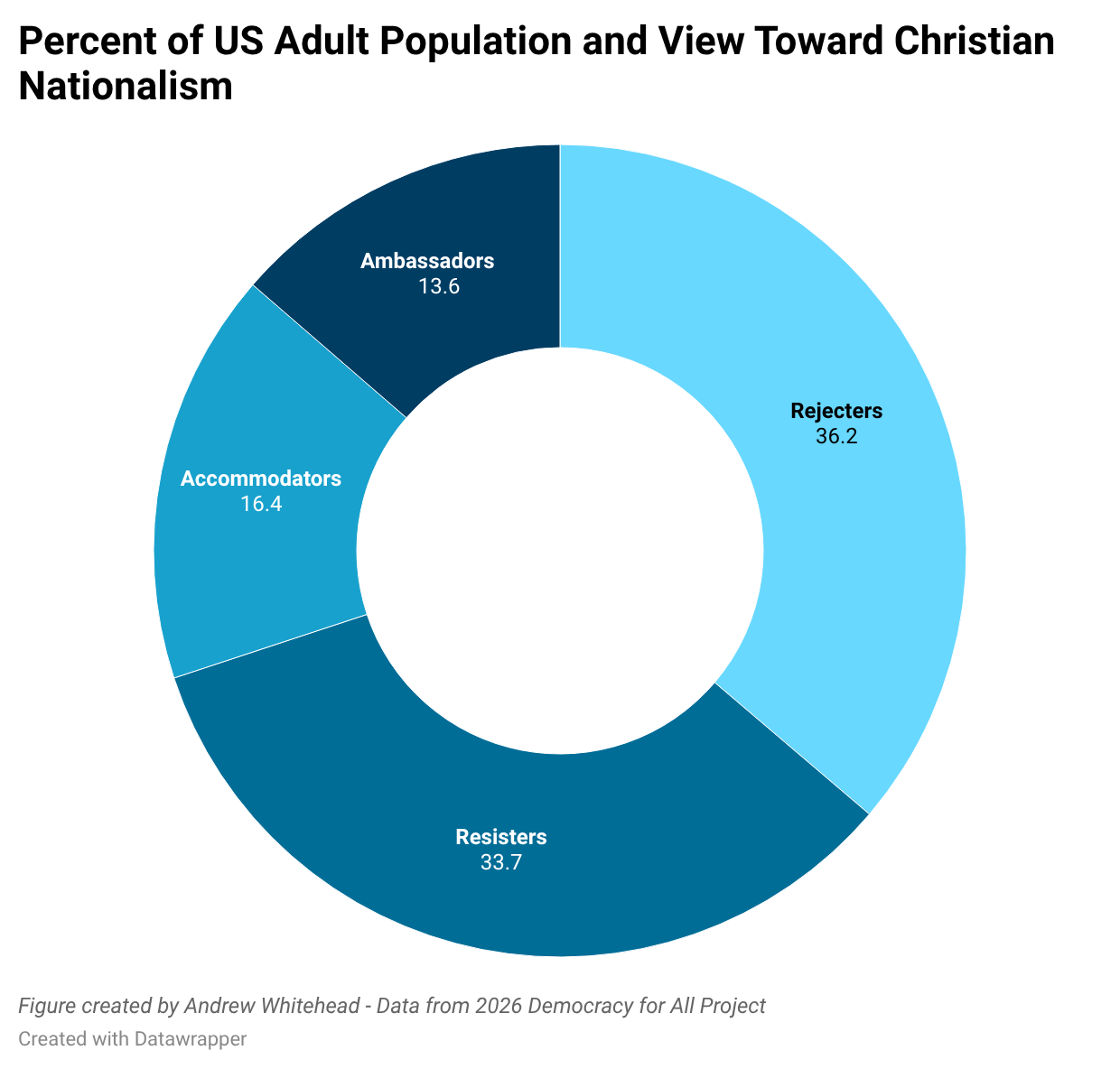
Aligning with other recent surveys of the American public, the Kettering-Gallup 2026 Democracy for All Project survey found that around 14% of the US population strongly embrace Christian nationalism; I will refer to this group as “Ambassadors.” Just over 16% of respondents are sympathetic toward Christian nationalism; I call those respondents “Accommodators.” A third (33.7%) of Americans are considered “Resisters” of Christian nationalism, and even more, 36%, are “Rejecters” of Christian nationalism.
The Democracy for All Project survey also provides insight into which demographic groups embrace Christian nationalism. In the table below we see that 31% of White Americans are at least sympathetic to Christian nationalism (either as Ambassadors or Accommodators), while 28% of Black Americans and 32% of Hispanic Americans say the same. Only 23% of respondents who identify with another race are at least sympathetic to Christian nationalism.
A third (32.6%) of men are either Ambassadors or Accommodators of Christian nationalism, while 28% of women respond similarly. Very few nonbinary respondents (8.6%) are sympathetic to Christian nationalism. Regarding education, 25% of respondents who have a bachelor’s degree or higher are either Accommodators (11%) or Ambassadors (14%). This is less than the number that are Resisters (27%) or Rejecters (48%).
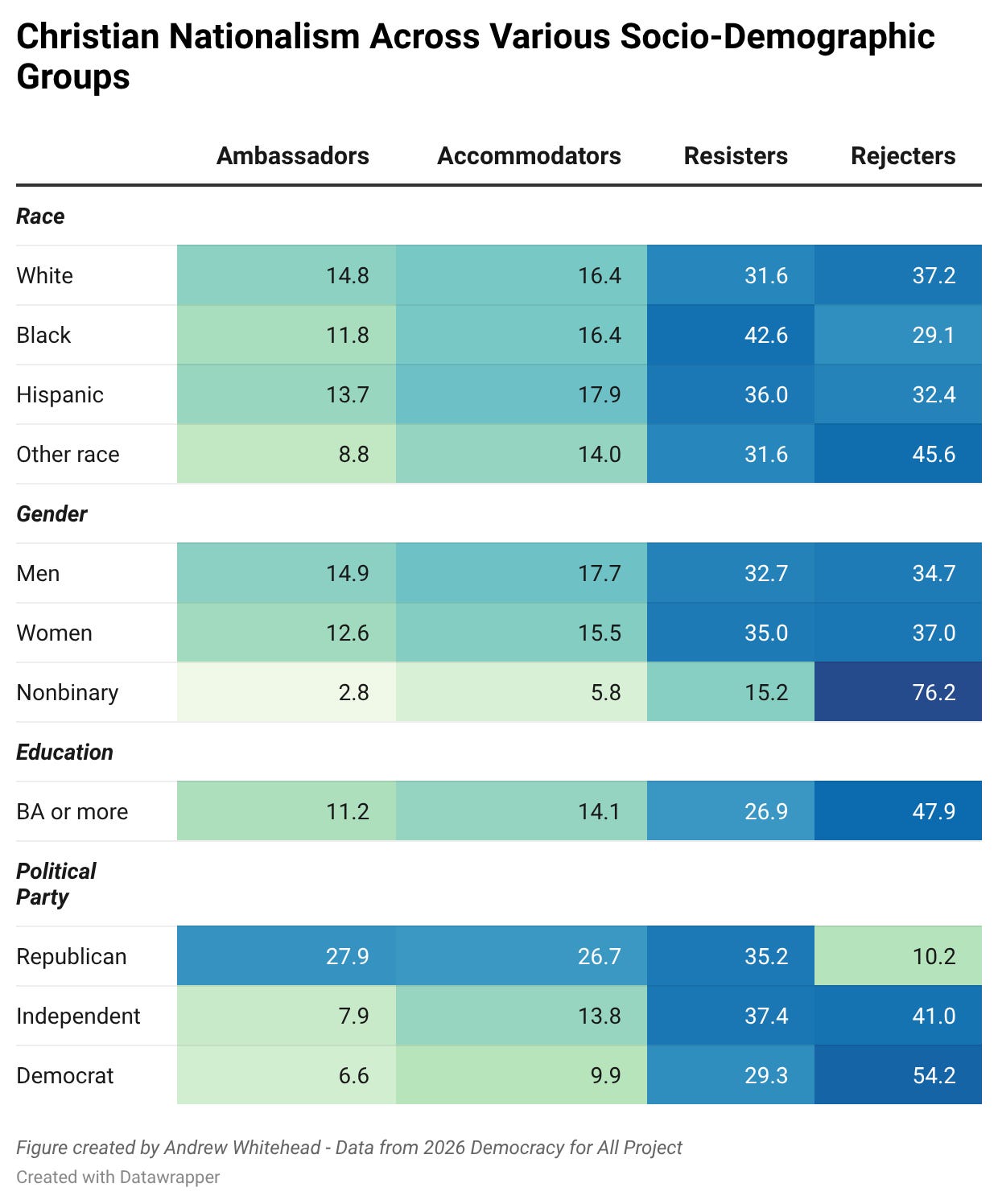
Christian nationalism is also strongly associated with political party. Over half of Republicans (55%) are either Ambassadors or Accommodators of Christian nationalism. Only 22% of Independents and 17% of Democrats are either Ambassadors or Accommodators. The widespread embrace of Christian nationalism by the Republican Party underscores the ongoing political relevance of Christian nationalism given the two-party system that dictates US politics.
Christian Nationalism and Democracy: A Disconnect
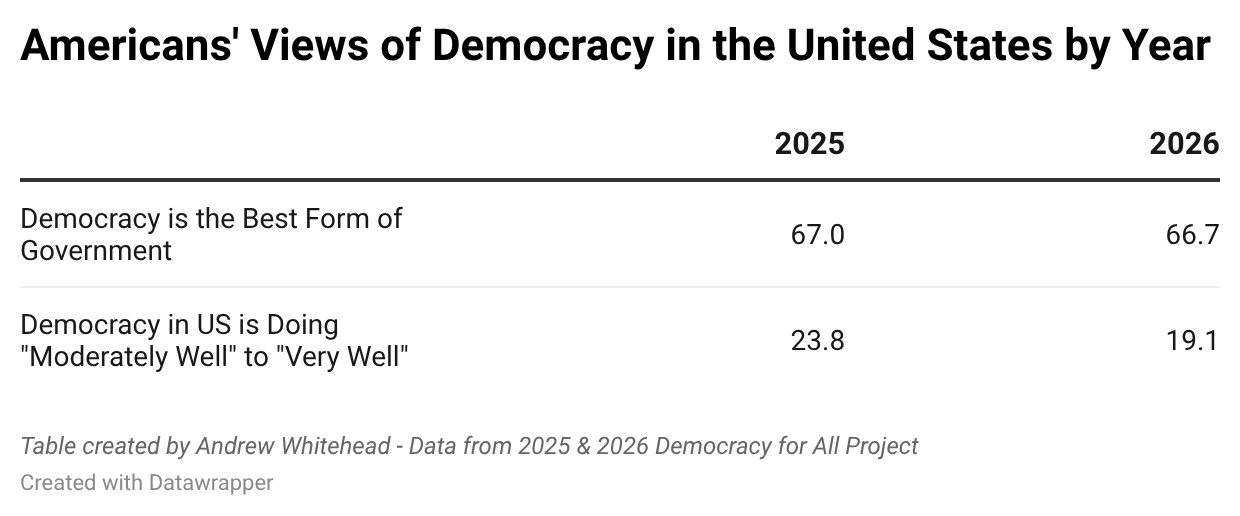
As we will see, most Americans agree that democracy is the best form of government. In the table below, the 2025 and 2026 reports of the Democracy for All Project survey show two-thirds of Americans agree with the statement “Democracy is the best form of government.” However, there is a slight decrease over the last year in the number of Americans who believe that democracy in the US is doing “moderately” or “very well.” In 2025, around 24% answered this way, but in 2026, only 19% responded the same.
In the figure below, we can see that a majority of each Christian nationalism group—Ambassadors to Rejecters—agrees democracy is the best form of government. Hidden within these numbers, however, is an important story about what democracy means for Americans who either embrace or reject the idea that the United States is and should be a Christian nation. When supporters of Christian nationalism say they prefer democracy and are working to defend it, they are envisioning a very different state of affairs compared to Americans who reject Christian nationalism and also state they prefer democracy. This is why some supporters of Christian nationalism can claim they prefer democracy and are working to defend democracy, while also advocating for limiting voting rights. Democracy, in their minds, is for true citizens who are Americans and that are largely sympathetic to Christian nationalism.
When asked whether democracy is doing “moderately well” or “very well,” there is a clear divergence. About 44% of “Ambassadors” believe democracy in the US is doing “moderately” or “very well.” A third (33%) of “Accommodators” say the same. Many fewer “Resisters” (17%) and “Rejecters” (5%) of Christian nationalism believe democracy is doing well in the United States.
This is a clear signal that Ambassadors and Accommodators likely have a different definition of democracy compared to Resisters and Rejecters. While 70% of Rejecters of Christian nationalism think democracy is the ideal form of government, only 5% of this group believes their vision of “democracy” is doing well here in the United States.
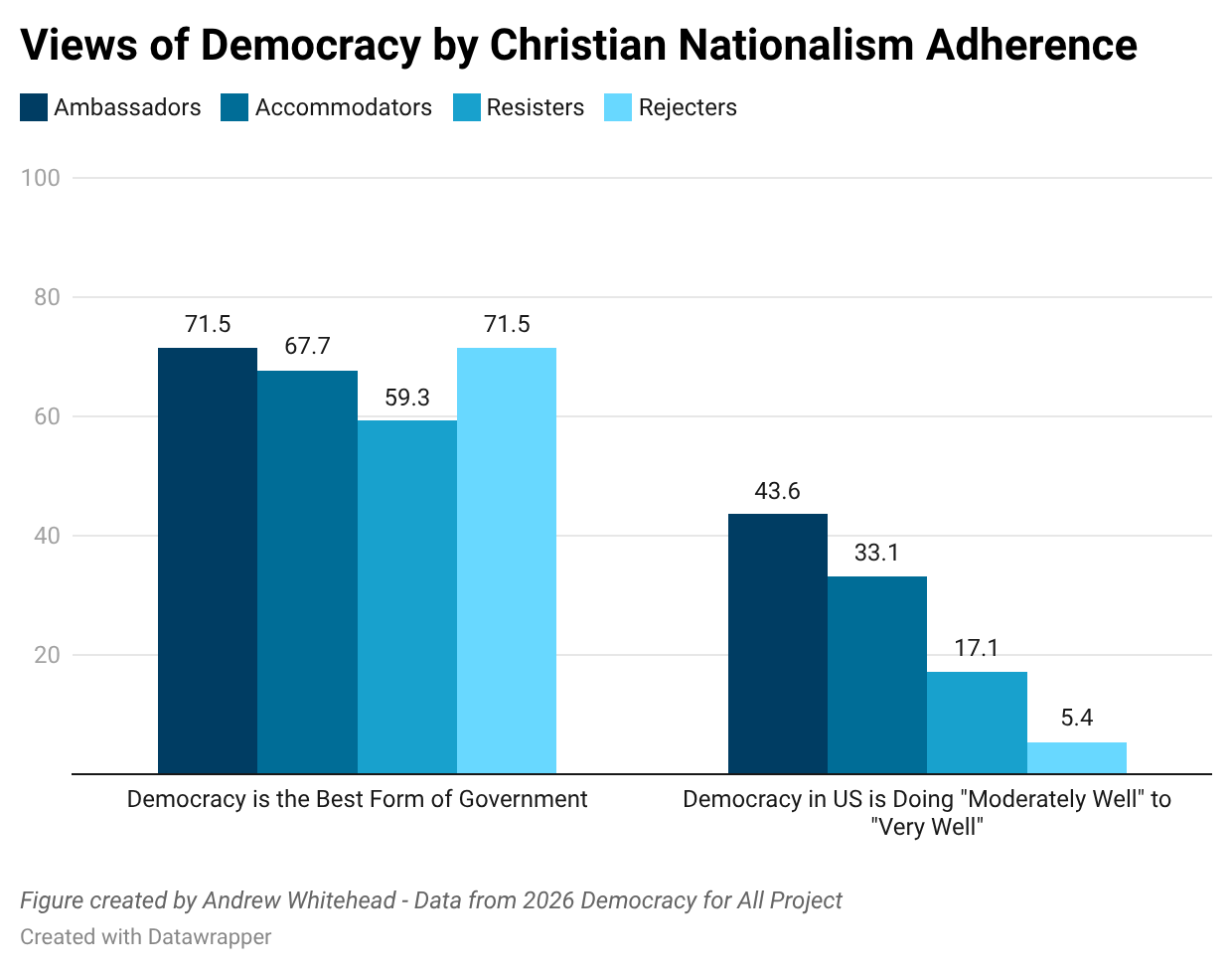
This divergence suggests several possible explanations. First, Americans who embrace or reject Christian nationalism are likely concerned with different political and social issues regarding the functioning of democracy in the United States. Second, the four Christian nationalism groups likely diverge in their attitudes toward various democratic principles like political compromise, diversity, or the role of government in meeting people’s basic needs. Finally, the four groups may differ in their views toward how the various branches of the federal government are functioning and how their power should be distributed.
First, Christian nationalism is linked to differing levels of concern regarding important social and political issues. In the figure below, Ambassadors, and to some extent Accommodators, of Christian nationalism are worried a great deal about ineligible voters participating in elections (64% and 47% respectively) and expanding government involvement (45% and 31% respectively). Many fewer Rejecters are worried about these issues.
Rejecters of Christian nationalism, however, are much more worried about people being harmed during peaceful protests (63%). Half as many Ambassadors (31%) and Accommodators (23%) signal that they are worried about this issue, however.
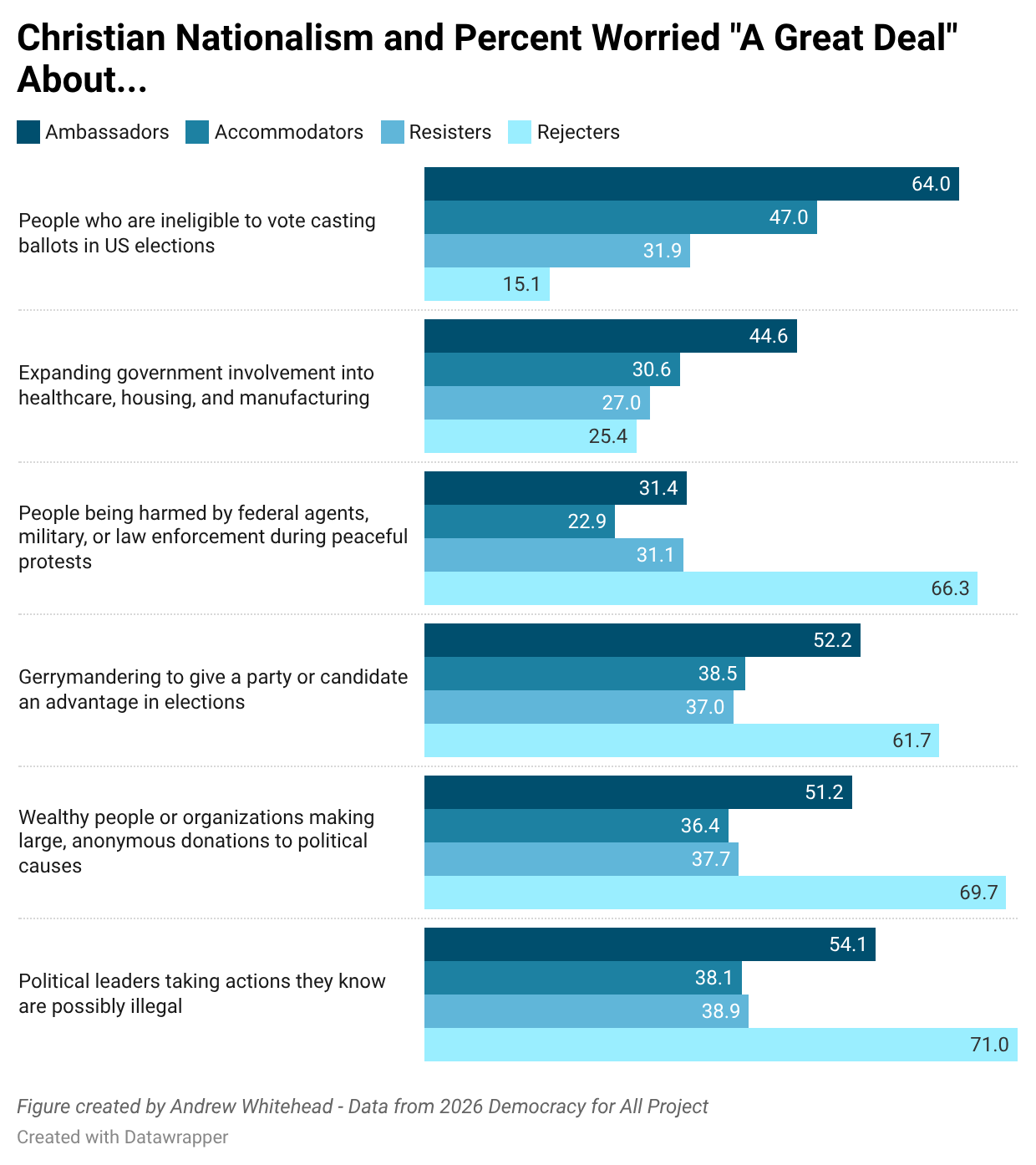
Interestingly, the last three issues shown in the figure above depict a horseshoe-shaped relationship with Christian nationalism, where more Ambassadors and Rejecters report being worried about each issue than are Resisters and Accommodators. Americans on the polar ends of Christian nationalism are more worried about gerrymandering, wealthy people donating to political causes, and unethical political leaders.
If we were able to interview Ambassadors and Rejecters about each of these issues, we would likely find that they are mostly worried about the “other side” gaining a political advantage through these practices. However, it is instructive that these two groups do recognize each issue as a threat to their particular vision of democracy.
Christian Nationalism and Democratic Principles
Diverging attitudes toward various democratic principles reveal a second explanation for the difference in attitudes about how well democracy is working. The next six figures provide examples.
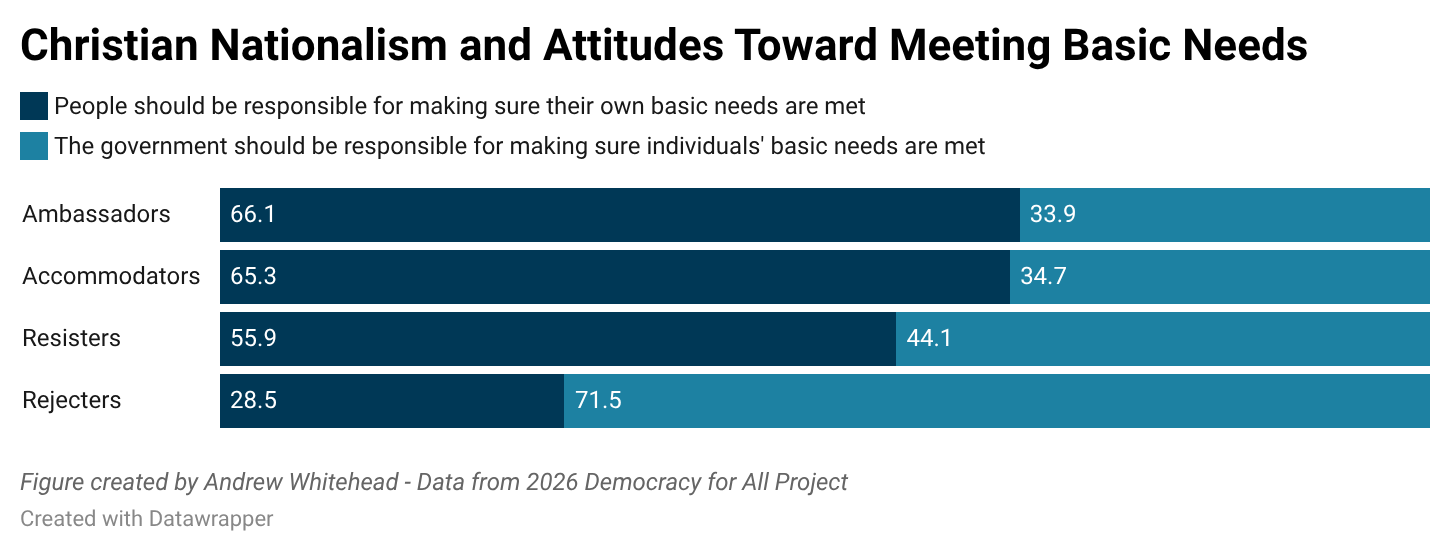
When given a choice between whether people should meet their own basic needs or if the government should be responsible for doing so, two-thirds of Ambassadors and Accommodators say it is each person’s responsibility. Rejecters of Christian nationalism overwhelmingly believe (72%) that it is the government’s responsibility to make sure individuals’ basic needs are met.
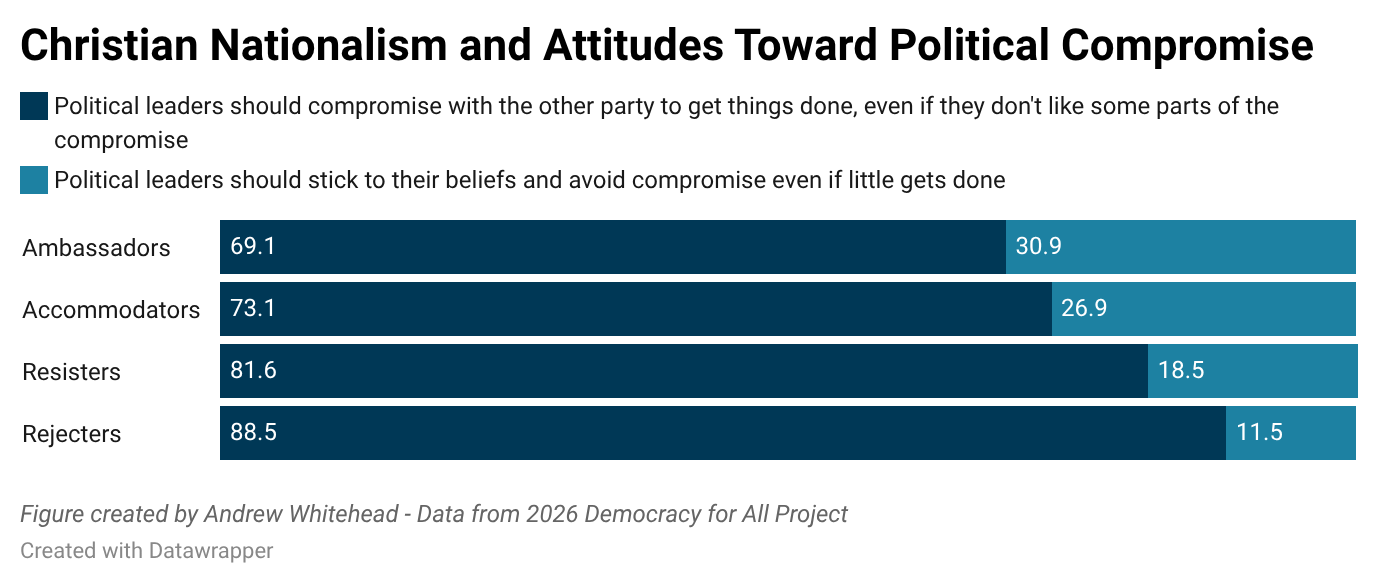
A majority of each Christian nationalism group believes political leaders should compromise, but almost three times more Ambassadors and Accommodators believe leaders should avoid compromise and stick to their beliefs. Given that compromise is central to democracy, these findings signal a divergence in how these groups define “democracy.”
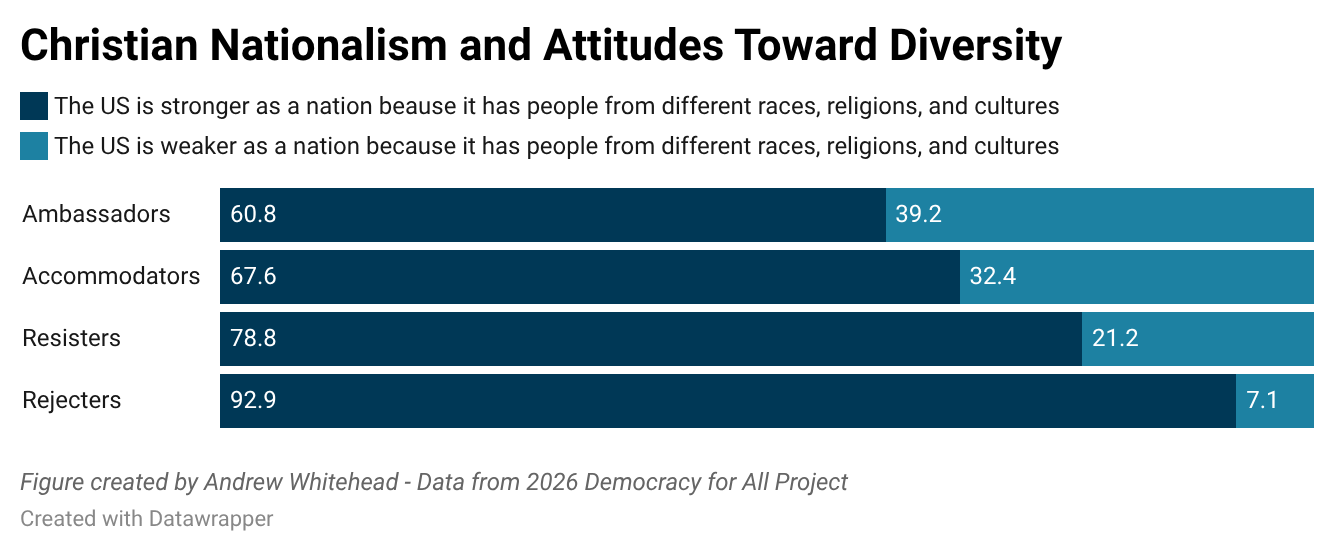
One of the central cultural markers of Christian nationalism is a desire for ethno-racial boundaries around national identity, which diverges from the foundational commitments of a pluralistic, democratic society where diversity in various forms is valued. So, while a majority of each Christian nationalism group chose the option that the US is stronger because of racial, religious, and cultural diversity, many more Ambassadors (39%) and Accommodators (32%) of Christian nationalism see these forms of diversity as a weakness. Many fewer Rejecters (7%) see diversity as a weakness.
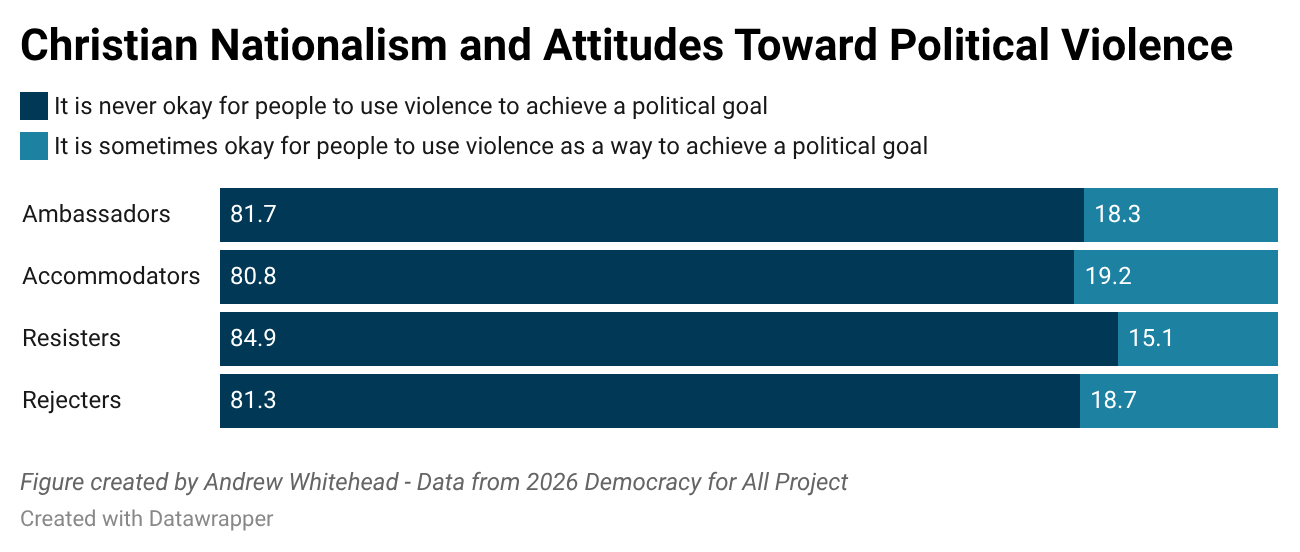
Another feature of a healthy democracy is the peaceful exercising and transfer of power. While some studies find a strong association between Christian nationalism and political violence, the 2026 Democracy for All Project survey shows that four out of five members of each Christian nationalism group signal that it is never OK to use violence to achieve a political goal. This is a welcome sign as we move toward the upcoming midterm elections.
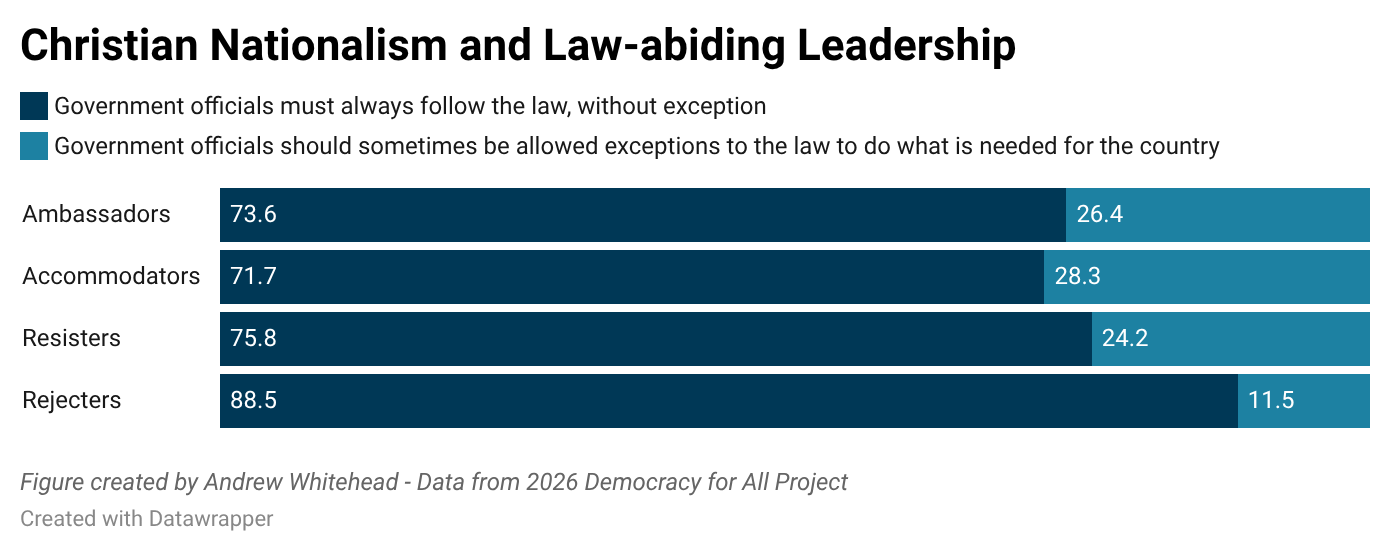
Ethical and law-abiding leadership is central to any healthy democracy. Yet again, majorities of each Christian nationalism group chose the option stating, “Government officials must always follow the law, without exception.” However, a quarter of Ambassadors, Accommodators, and even Resisters believe officials should sometimes be allowed exceptions to always acting lawfully. Only 12% of Rejecters say the same.
A final explanation as to why adherence to Christian nationalism is linked to beliefs about the functioning of democracy is that the groups differ in their views of what should be expected of citizens in support of democracy in the current moment. Rejecters overwhelmingly believe citizens’ most important responsibility is “speaking up against injustice” (91%). Six in ten Resisters (63%) agree. Half of all Ambassadors and Accommodators of Christian nationalism, however, believe the most important responsibility of citizens right now is “respecting authority.”
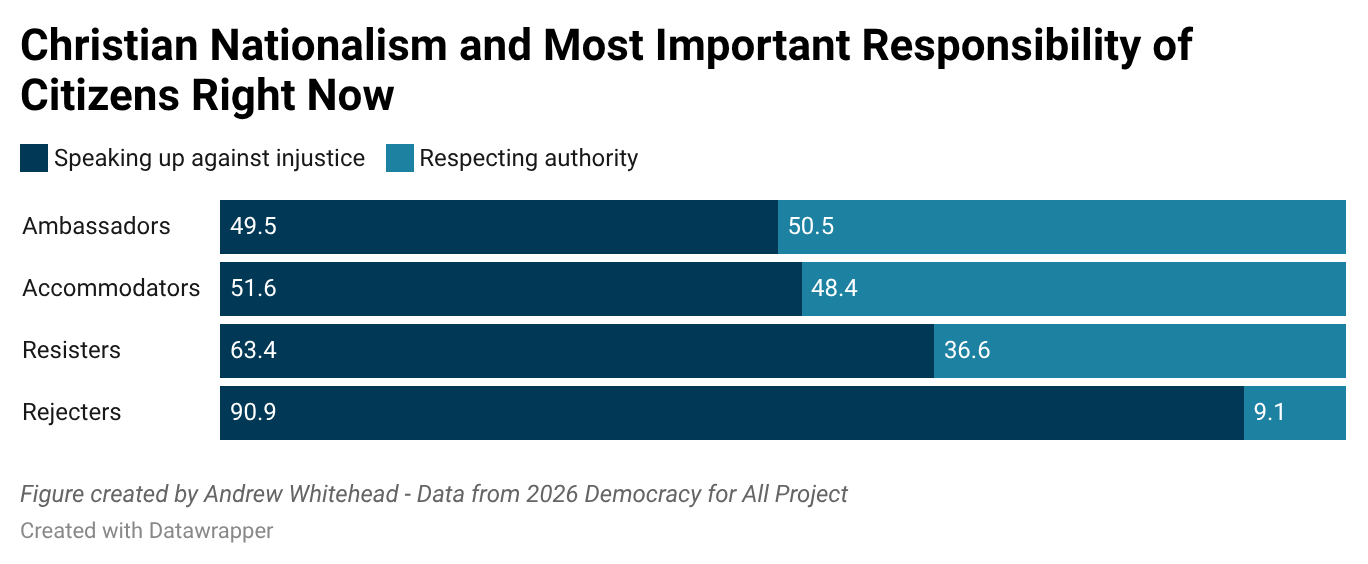
These figures provide insight into how and why the Americans who are spread across the four groups of Christian nationalism differ in whether they think “democracy” is functioning well. Rejecting or embracing Christian nationalism is clearly linked to divergent views of what a health democracy entails. Americans’ views toward Christian nationalism will likely influence how they perceive upcoming national political events like the midterm elections.
Project 2025 and Democracy Satisfaction
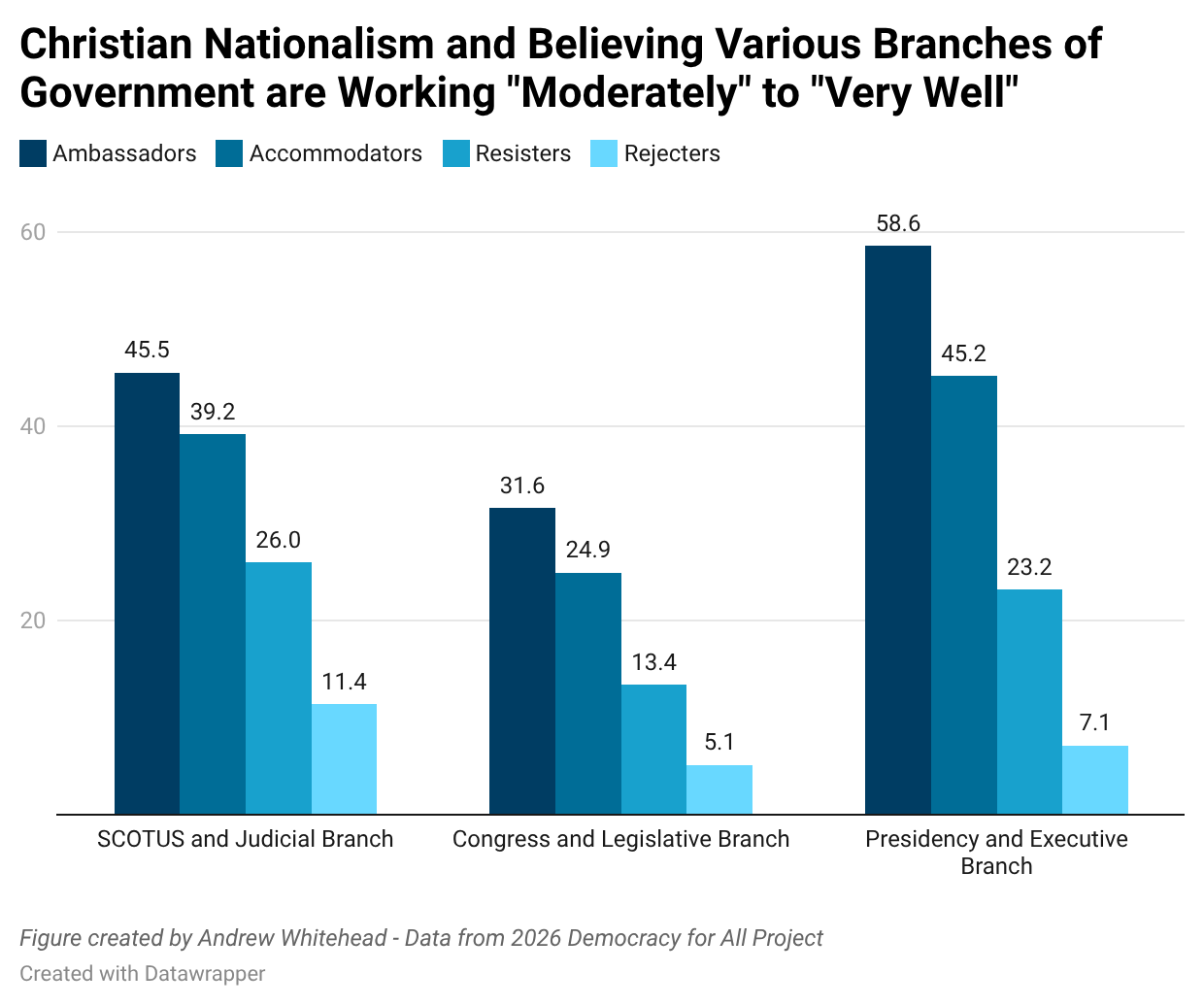
A final explanation as to why the four groups differ in whether they think democracy in the US is functioning well is their views on whether the federal government, and its three branches, is functioning well. The dominance of Christian nationalism within the Republican Party is one reason why we are living through a moment where Christian nationalism has unparalleled political and policy influence. Project 2025, an explicitly Christian nationalist blueprint for the second Trump administration, aims to localize power within the executive branch. In doing so, the goal is to severely weaken the checks and balances mandated by the US Constitution among the three branches of the federal government in favor of the Republican Party, which controls the presidency. Survey data from the Democracy for All Project allows us to examine the effectiveness of Christian nationalism and Project 2025. When Americans were asked to share whether they think each branch of the federal government is working “moderately” or “very well,” we again see a clear divergence of attitudes across the four Christian nationalism groups (see figure below). Ambassadors have the most positive views across all three branches of government, followed by Accommodators, while Resisters and especially Rejecters report much less positive assessments.
Comparing how Christian nationalism shapes Americans’ assessments of the three branches of government is fascinating as well. By far, Ambassadors have the most positive evaluations of the functioning of the presidency and executive branch, with 59% saying it is working “moderately” or “very well.” The judiciary and the Supreme Court (46%) follow, with Congress and the legislative branch coming in last (32%). The same pattern follows for Accommodators: the presidency, SCOTUS, and then Congress are rated positively by 45%, 39%, and 25%, respectively.
For Resisters and Rejecters of Christian nationalism, the assessments are first SCOTUS (26%; 11%), then the presidency (23%; 7%), then Congress (13%; 5%). Clearly, Americans who embrace Christian nationalism mostly believe the branches of the federal government are working well. For Americans who resist Christian nationalism, the vast majority do not believe the branches of government are functioning well.
Remember, Project 2025 aimed to localize power within the executive branch. The 2026 Democracy for All Project survey allows us to see if the millions of Americans who embrace Christian nationalism similarly embrace this goal.
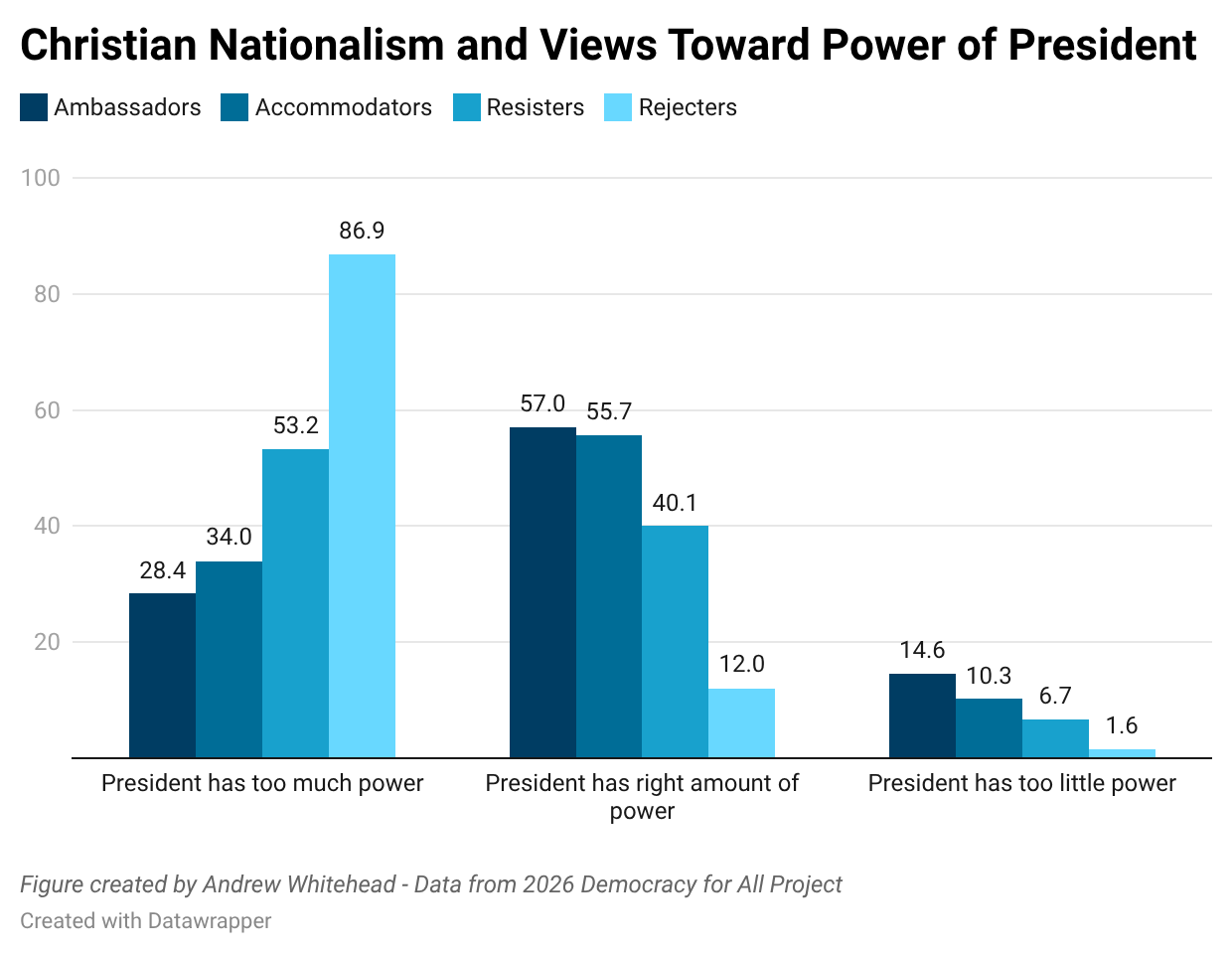
In the next figure, we see clear evidence of this exact desire across the American population. Over two-thirds of Ambassadors and Accommodators of Christian nationalism believe that the president has too little power (15%; 10%) or at least the right amount of power (57%; 56%). Conversely, Rejecters of Christian nationalism overwhelmingly believe the president has too much power (87%), with over half of Resisters saying the same (53%).
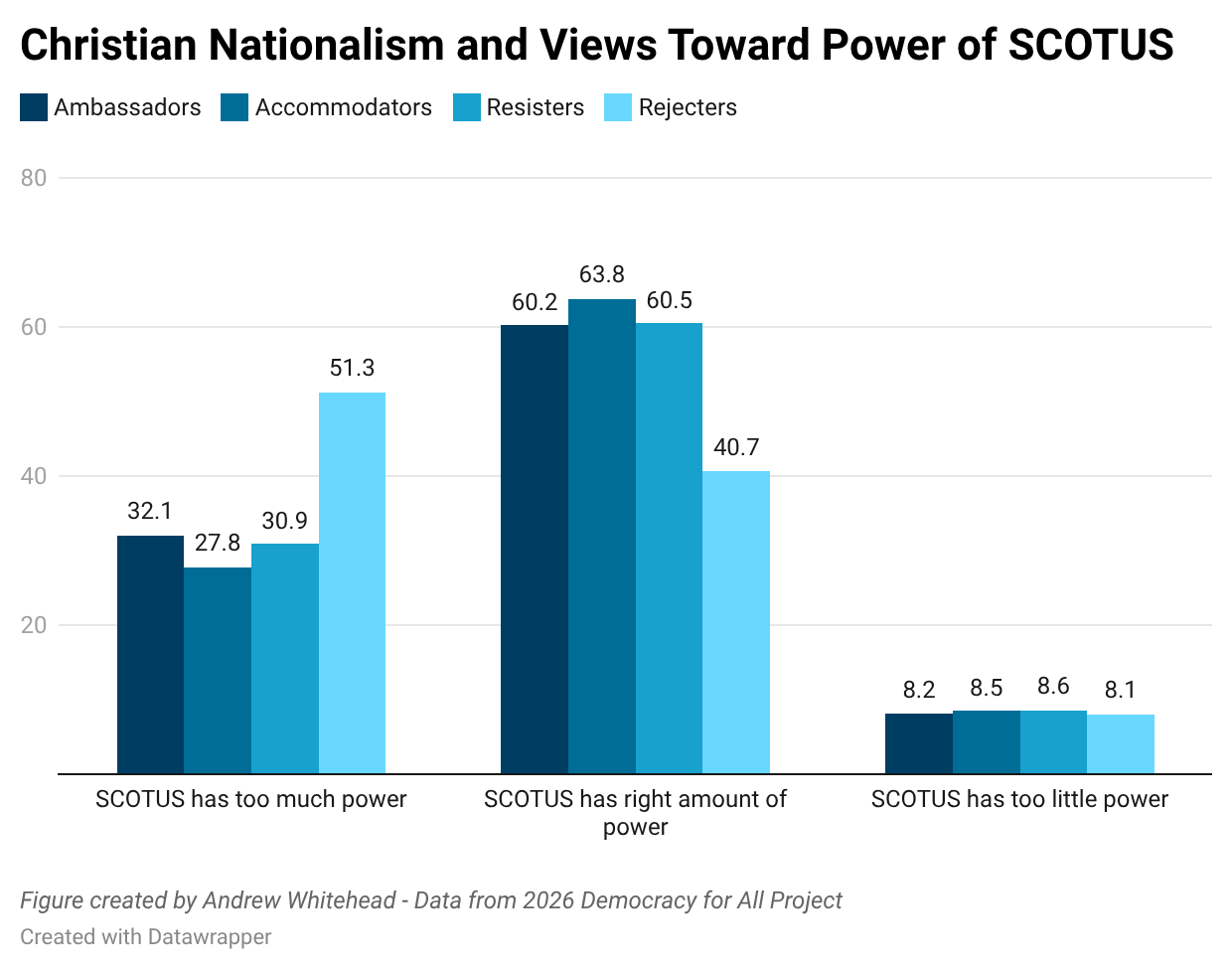
The views toward SCOTUS, as seen in the figure below, show most Ambassadors, Accommodators, and Resisters align in whether they think the highest court in our country has too little, too much, or the right amount of power. Over half of Rejecters (51%), however, believe SCOTUS has too much power.
It is likely that Rejecters see SCOTUS as enablers of the presidency, rather than a check on executive power, which may be why so many more Rejecters believe SCOTUS has too much power. It aligns with their view that the presidency has too much power. For Ambassadors and Accommodators who tend to be much more supportive of the policy goals and power of the current presidency, they overwhelmingly believe SCOTUS has the right amount of power, particularly when it allows the current president to move forward with his administration’s policy goals.
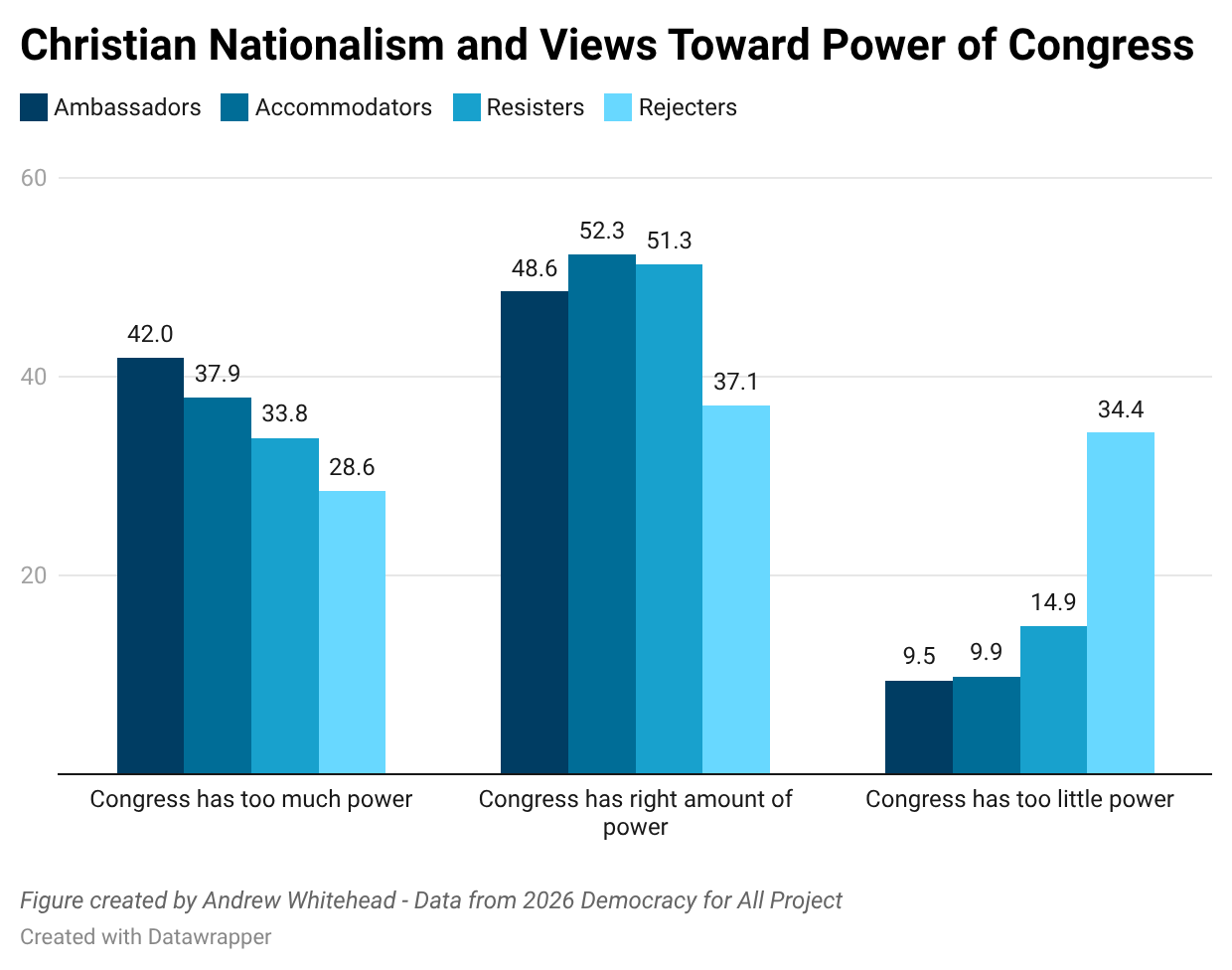
The views toward the power of Congress (see figure below) clearly reveals how Christian nationalism shapes Americans’ views toward the separation of powers across the three branches of the federal government. Around 40% of Ambassadors and Accommodators believe Congress has too much power while half believe Congress has the right amount of power. Very few who embrace Christian nationalism think Congress has too little power.
Rejecters of Christian nationalism, however, see things very differently. Over one-third (34%) believe Congress has too little power, over twice as much as any other Christian nationalism group. Examining this result alongside Rejecters’ views toward the power of the presidency and SCOTUS, it is clear Rejecters hope to see the legislative branch exercise much more of its constitutional power as check on the executive and judicial branches.
Taken together, these last three figures are evidence that the millions of Americans who embrace Christian nationalism are on board with the underlying political strategy of Project 2025. Ambassadors of Christian nationalism want to see an executive branch exerting more power over policy and the direction of the country, with a deferential judicial branch, and a legislative branch that is either maintaining or absolving itself of its constitutionally mandated power.
Since Christian nationalism disdains diversity and believes a subset of Americans are the truest citizens, it makes sense that adherents are skeptical of Congress, the branch of government most likely to contain diversity of all kinds—political, socio-demographic, and religious.
Furthermore, because Congress is so large it is the branch of government that is hardest to bring into complete ideological and political alignment. There will always be representatives and senators who represent districts and states where Christian nationalism is much less influential.
Therefore, as Christian nationalism is clearly focused on gaining and wielding power to move the country toward a particular vision, the presidency and SCOTUS provide much clearer paths toward achieving the ideological purity and unfettered exercise of power commonly associated with authoritarian regimes.
What does all this mean for how Americans view the future of democracy in the United States and the role of Christian nationalism in shaping that vision? Perhaps unsurprisingly, it is Americans at the polar ends of the Christian nationalism spectrum—Ambassadors and Rejecters—who see change on the horizon.
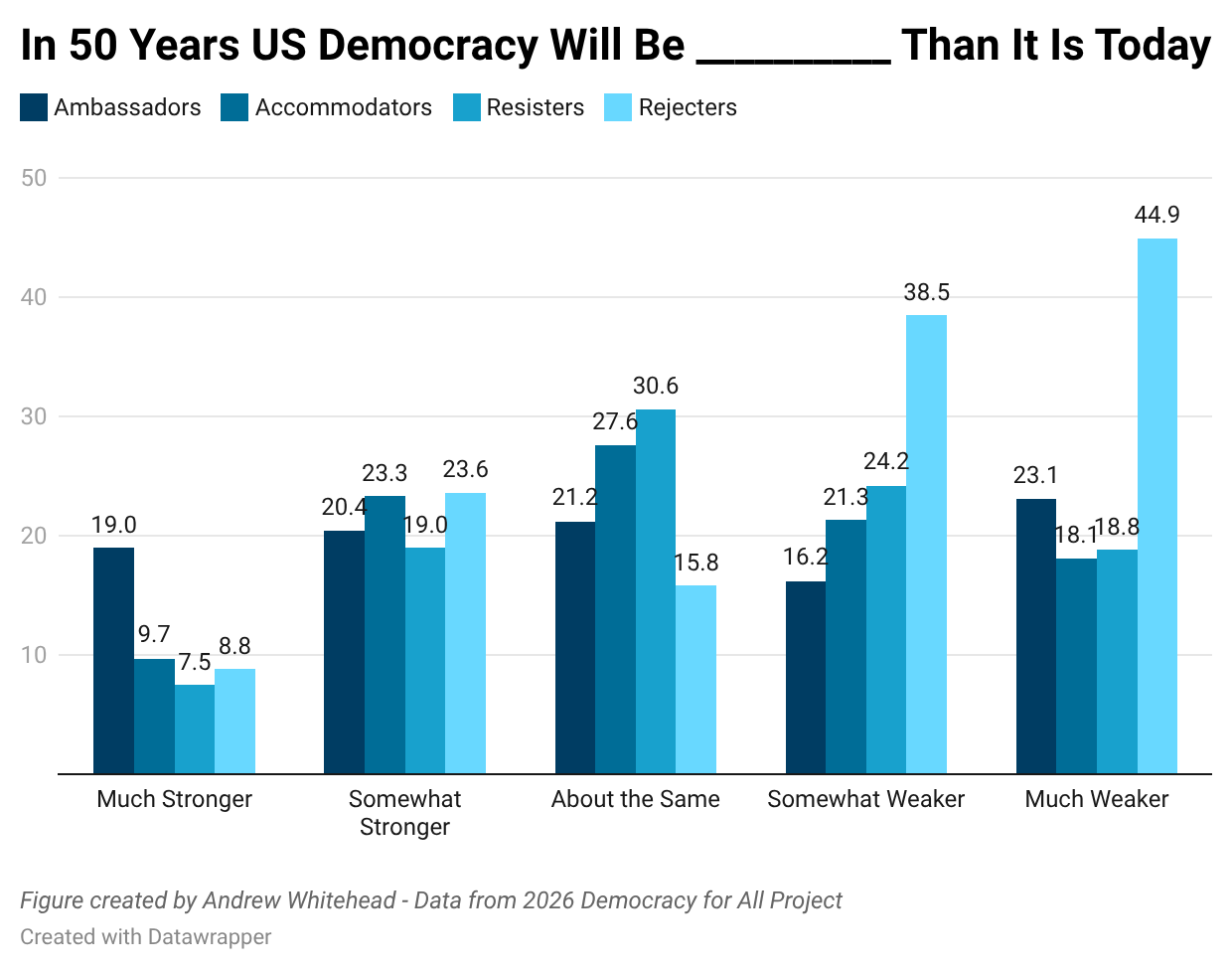
As the figure above shows, twice as many Ambassadors (19%) than any other group believe US democracy will be “much stronger” in 50 years compared to today.
Conversely, over four out of five Rejecters of Christian nationalism believe US democracy will be “somewhat weaker” (39%) or “much weaker” (45%) in 50 years, far outpacing any other group.
In sum, the 2026 Democracy for All Project reveals that the Christian nationalist vision of Project 2025, which aims to focus power within the executive branch of the federal government to privilege a particular subset of American citizens, is a vision that appeals to the millions of Americans who embrace Christian nationalism. This survey also helps us make sense of why a majority of Americans still agree that democracy is the best form of government, while having dramatically different views on whether democracy in the US is functioning well.
Christian nationalism casts a vision for a very specific preferred citizenry and leadership in this country, one that elevates a privileged few, as the truest expression of a healthy democracy. For those who embrace Christian nationalism the current administration’s achievements are a big reason they believe democracy in the US is doing well.
For those who reject Christian nationalism and are committed to an inclusive, pluralistic, democratic society, the 2026 midterm elections and the years to follow will contain opportunities to pursue their vision for democracy in the United States.
As the data in this report lay bare, Americans who embrace Christian nationalism and those who reject it have dramatically different visions of what democracy even means. This limits opportunities for finding common ground around protecting and strengthening democracy in the United States.
However, the 2026 Democracy for All Project survey provides a key insight into how to effectively counter the push toward authoritarianism wrapped up in the Christian nationalist version of democracy. Fifty-nine percent of Americans believe the executive branch and presidency have too much power. This signals that a clear majority of Americans are ready and willing to support the checks and balances of power mandated in the United States Constitution across the three branches of the federal government.
Electing and empowering Congressional representatives who are committed to wielding their constitutional power is a vital first step to responding to our nation’s slide toward a personalist authoritarian regime.
We are living through a moment where we must—yet again—determine if, as President Lincoln identified in his dedication of the Soldier’s National Cemetery in Gettysburg, our “government of the people, by the people, for the people, shall not perish from the earth.”
Andrew L. Whitehead is professor of sociology at Indiana University Indianapolis, codirector of the Association of Religion Data Archives, and a Charles F. Kettering Foundation Research Fellow. Follow him on Bluesky and Substack.
From Many, We is a Charles F. Kettering Foundation blog series that highlights the insights of thought leaders dedicated to the idea of inclusive democracy. Queries may be directed to fmw@kettering.org.
The views and opinions expressed by contributors to our digital communications are made independent of their affiliation with the Charles F. Kettering Foundation and without the foundation’s warranty of accuracy, authenticity, or completeness. Such statements do not reflect the views and opinions of the foundation which hereby disclaims liability to any party for direct, indirect, implied, punitive, special, incidental, or other consequential damages that may arise in connection with statements made by a contributor during their association with the foundation or independently.