

Too often, when we speak about democracy, we speak about it in either backward-looking or presentist terms: “democracy is backsliding” or “democracy is in danger.” However, we spend too little time thinking about how we can build, reconstruct, and reconstitute democratic peoples, practices, and possibilities so that democracy remains our best option for governance in the 21st century and beyond. At this critical juncture, it is crucial that we think about democracy through the lens of futurity.
The Present Predicament
Unfortunately, we’re in a situation where most Americans feel that their democratic institutions are failing them. They fear for the rule of law and are skeptical that democracy will get stronger in the coming years and, more devastatingly, are worried that their children’s life chances are worse than theirs have been.
People are lonelier, less trusting, and more pessimistic than they have been in a hundred years, and we can’t fix what ails our democracies without shoring up the containers that allow us to build connection, social trust, public skills, and political efficacy. An antisocial society cannot produce a democratic people, no matter what decision-making institutions we’ve put in place. Most people’s outlooks are poor, but the most recent Kettering-Gallup Democracy for All Project survey shows that those who have maintained a more hopeful and agentive outlook are people who feel strongly connected to their local communities. These folks are more likely to participate locally, think that democracy is the best form of government, believe that governing institutions can perform well, and believe that they can make positive political changes.
Cultivating a Democratic People
We are familiar with the concept of “the future,” we sometimes even speak about futures but, in each case, we are usually referring to the time that will come with or without our intervention. Futurity, on the other hand, is a concept of the future that incorporates a sense of agency into our notions of the world to come and assumes that we are tasked to help shape it. Futurity is a disposition toward thought and action that insists that we have a role to play in building the world we wish to share in the decades to come.
Understanding democracy through the lens of futurity requires us to affirm how democratic societies and citizens are made and what we are made of so that we know how to focus our attentions on not only what must be defended but also on what must be cultivated, supported, and constructed. The affirmative process of using our powers of logical assessment and practical strategy along with our capacity for vision and imagination is one that I call worldbuilding.
Democracy is built up from a foundation. The foundation for democracy must include the background conditions of relative material equality and an active, connected citizenry. Each of these background conditions has been undervalued in the study of democratic functioning. Instead, there has been an emphasis on institutions, law, policy, political attitudes, and behavior. However, neither institutions nor law alone ensure the capacity for the adaptability and endurance of democracy. That capability relies on a connected and active citizenry.
Only from a democratic people can a politics of futurity emerge. This democratic people must cultivate the political care, build the social trust, and nurture the collective intelligence, practical know-how, and power for the reconstructive politics that is necessary for our thriving.
As I have argued elsewhere, social movements are necessary for keeping democracy from being trapped and broken within what Max Weber called the “iron cage” of bureaucracy—dehumanization, expropriation, and stagnation. But social movements derive their capacity to build power that demands accountability from decisionmakers (or removes them from power) and from a people who are organized, connected to one another, and believe that they have political efficacy.
Democratic Worldbuilding
The good news is that there are myriad ways that people are practicing a politics of futurity by building trust and building parallel institutions toward a more caring politics. Worldbuilding requires us to cultivate new repertoires of political action. I have written about a Black feminist repertoire for worldbuilding that includes an underlying purpose rooted in a politics of care and uses political strategies of storytelling and institution-building, which I call “fabulation with fabrication” and incorporates tactics inspired by the figure of the folkloric Trickster. I call this goal of democratic redesignand reconstruction worldbuilding.
There are several ways that people are using new repertoires for worldbuilding to invent adaptive ways of doing democracy. These repertoires rebuild, reconstruct, or reconstitute the foundations for connection, social trust, civic organization building, and political efficacy that we have allowed to decay over the last 50 years.
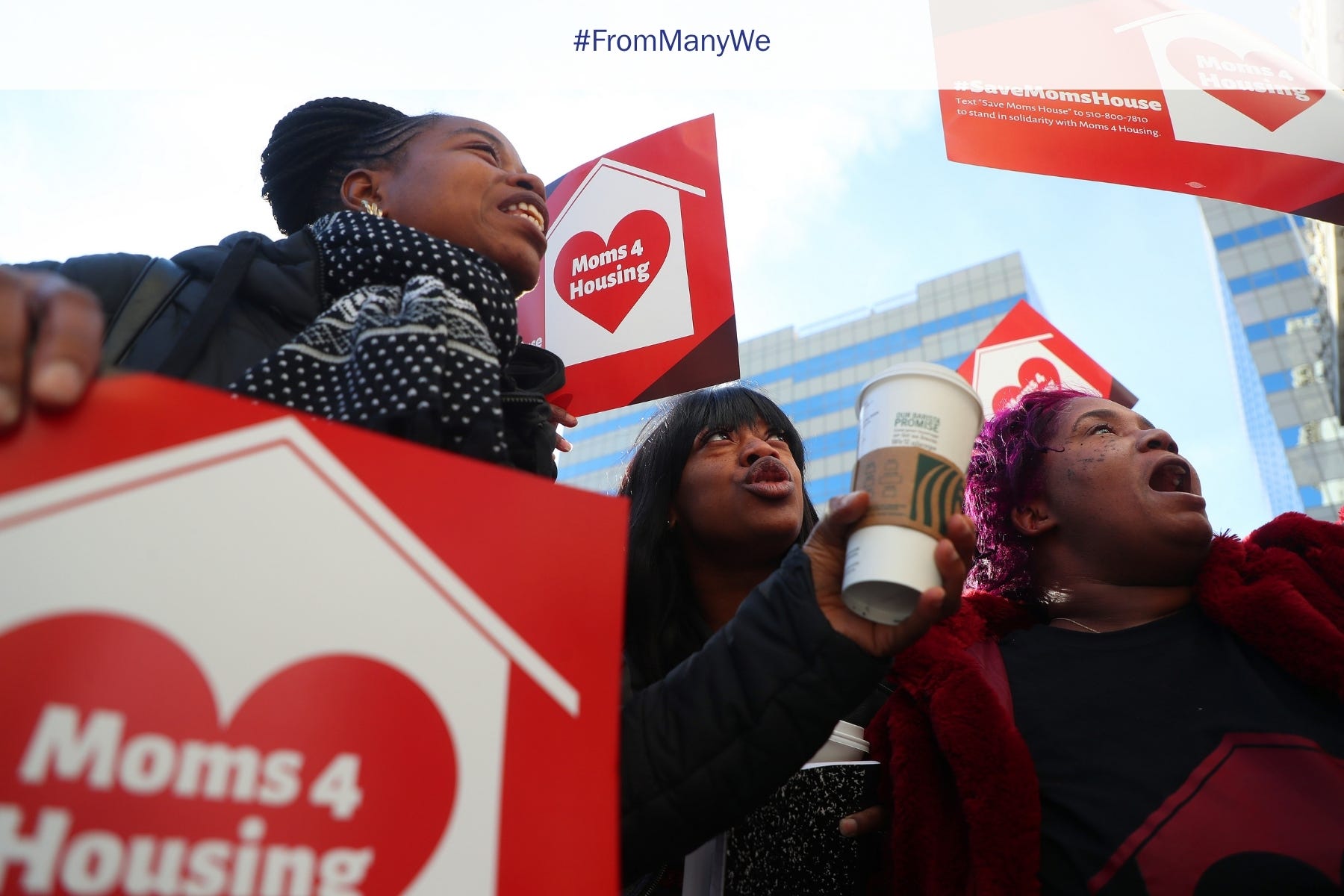
One example is a housing advocacy group called Moms 4 Housing in Oakland, California. In 2019, Dominique Walker, a woman who had become homeless due to the exorbitant cost of housing in her neighborhood, organized a group of mothers facing housing insecurity. The mothers understood that they faced high prices because a corporation called Wedgewood Properties had bought dozens of properties to flip for resale to richer, mostly White homebuyers who they hoped to attract to historically Black working-class neighborhoods. Not only did Wedgewood buy multiple homes at once, but it also held those houses vacant for months or years before they started the process of renovation into luxury properties. Of course, the corporation had no care about the communities that the empty houses sat in. And they had no legal obligation to the people who worked in the communities and could no longer afford to live there. Walker and Moms 4 Housing understood that a geography of dwellings that are kept empty—prevented from being used as homes—are antithetical to the wellbeing of the populations that live there. They decided that there was a moral and practical harm that needed to be addressed.
So one day in November 2019, Walker and Sameerah Karim, another mother who had been rendered homeless, walked with their children into a vacant, unlocked house that had been held empty for two years, and made it into a home they called “Mom’s House.” Sociologists Brandi Thompson Summers and Desiree Fields write:
The women not only claimed a space for themselves but also studied with and organized a large group of affected people in such a way that they were able to use loopholes and ambiguities in municipal laws to assert their right to claim the space they needed to live and begin to create conditions for thriving. . . . These actions forced Wedgewood to respond and be held accountable, publicly.
Moms 4 Housing used trickster tactics—working in a gray area of law and approaching the problem from an unexpected direction—to create the world that they needed to care for themselves and their community. In addition to claiming Mom’s House as their home, they turned it into a place where neighbors could gather, build social connections and trust, and analyze the practices and power dynamics that diminished their capabilities for living a flourishing life, thus creating a home base from which they could do something about it together. Through their efforts, Moms 4 Housing not only secured shelter for their families but also built a political coalition that led to changes in California law preventing corporations from buying up foreclosed homes in bulk. They took action to stop future housing shortages and destabilizing economic conditions that would further undermine belonging, connection, and social trust—the conditions for a democratic people to come into being.
Moms 4 Housing is not the only example. All over the country, people are cultivating different pathways that prepare their communities for active self-governance by building organizations and solidaristic bonds that are the necessary foundation of the power of a democratic people. After years of civic decline, we are seeing some counter-trends that have picked up in the last decade. We can see it in the three-fold growth in community land trusts, a form of collective land ownership that keeps property affordable and locally governed, since 2010. We are seeing an uptick in recreational clubs (particularly for in-person, phone-free group games like Mahjong) and the revitalization of old civic organizations like the Grange, an ecology focused social organization that has had a surge of young members over the past decade. We also see increased community building in the revitalization of the cooperative as a form of democratically owned enterprise and the proliferation of cooperative lenders who now manage billion-dollar funds. And communities throughout the US have seen an exponential growth of farmer’s markets since 2000, which have increasingly become social hubs for education, care work, political communication, and policy response.
These examples of people practicing a politics of futurity are not designed as defenses against autocracy, but they are the bulwark against democratic devolution—they are the foundations upon which a 21st century democracy will be built. Not because their institutional forms are perfect, or because they have power and influence, but because the work they do is what gives democracy its substance. A politics of futurity is the only way forward.
Deva Woodly is professor of political science at Brown University and a Charles F. Kettering Foundation research fellow.
From Many, We is a Charles F. Kettering Foundation blog series that highlights the insights of thought leaders dedicated to the idea of inclusive democracy. Queries may be directed to fmw@kettering.org.
The views and opinions expressed by contributors to our digital communications are made independent of their affiliation with the Charles F. Kettering Foundation and without the foundation’s warranty of accuracy, authenticity, or completeness. Such statements do not reflect the views and opinions of the foundation which hereby disclaims liability to any party for direct, indirect, implied, punitive, special, incidental, or other consequential damages that may arise in connection with statements made by a contributor during their association with the foundation or independently.