

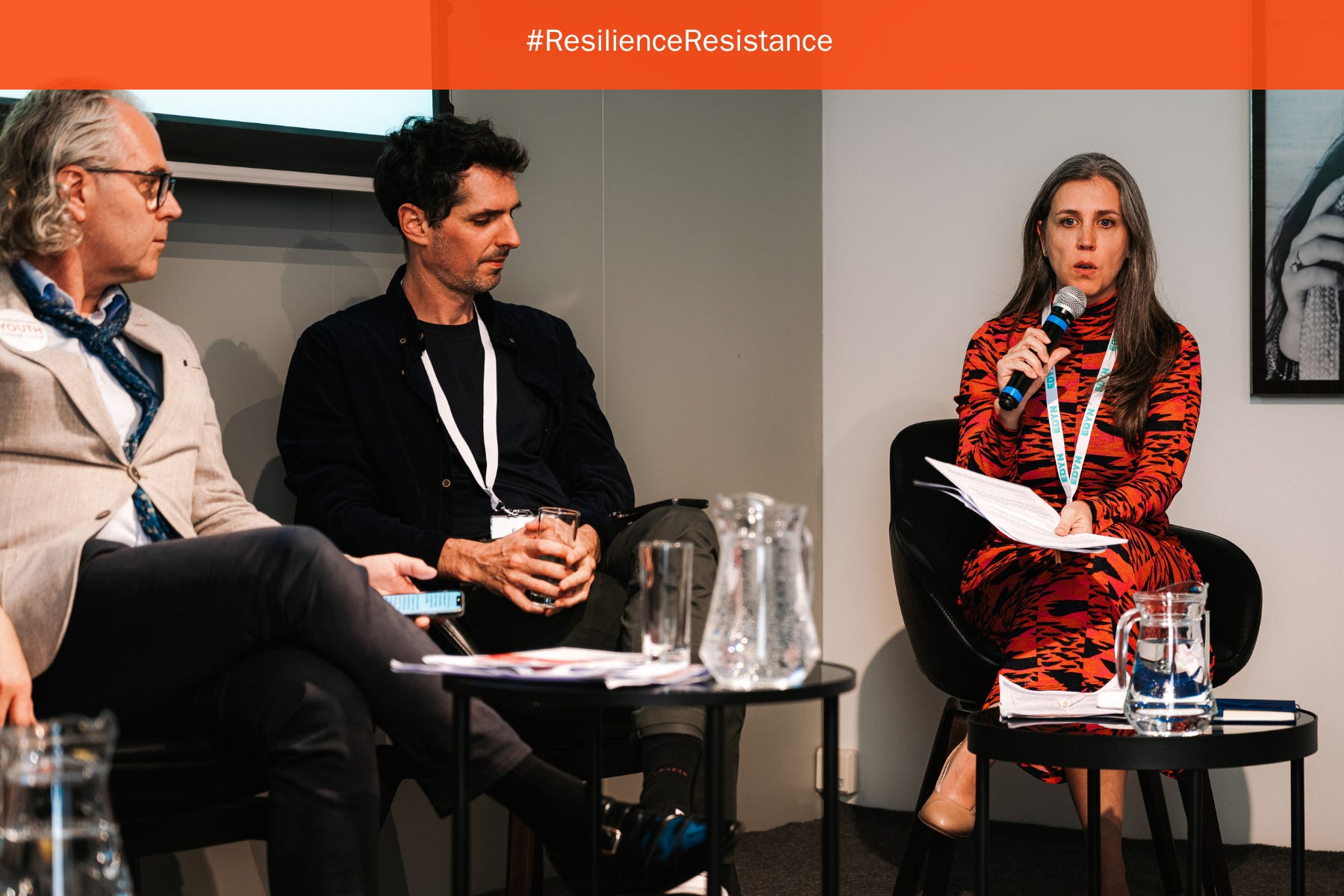
In 2026, the Global Democracy Coalition (GDC), an alliance of more than 180 democracy organizations worldwide, hosted four regional forums in partnership with local civil society member organizations. As part of the coalition, the Kettering Foundation sponsored these forums to support cross-border exchange, knowledge sharing, and collaboration. Insights from the regional forums will be shared during the GDC’s global forum in the fall. Elisenda Ballesté Buxó presented the remarks below at the opening of the European Regional Forum on May 19 in Prague.
This forum marks the third regional forum of the GDC this year and follows conversations already held in Africa and the Americas, with Asia still ahead of us. And I think that sequence matters. One of the clearest lessons emerging across regions is that while democratic contexts may differ, many of the pressures democracies are facing today are increasingly interconnected and structurally shared.
At the same time, the responses to those pressures often remain fragmented. And perhaps nowhere is that tension more visible than in Europe today. Europe remains home to some of the world’s strongest democratic institutions, regulatory frameworks, civic traditions, and human rights protections. Yet across the continent, we are simultaneously witnessing growing polarization, declining public trust, foreign interference, attacks on journalists and civil society, and disinformation ecosystems operating across borders.
The challenge is not simply that democracy is under pressure. Democracies have always faced pressure. The challenge is that many of the systems we rely on to govern democracy were built for a different speed, a different information environment, and a different political reality than the one we are operating in today.
We have seen this very clearly in the conversations leading up to this forum. There is a growing gap between the transnational nature of democratic threats and the fragmented nature of our responses. Disinformation does not stop at borders. Digital manipulation does not stop at borders. Illicit financial influence does not stop at borders. AI systems certainly do not stop at borders. And yet institutions, oversight mechanisms, and democratic cooperation itself often remain organized in much slower, more nationally confined ways.
And the stakes this year are particularly concrete. Europe is entering a critical period of elections: national, parliamentary, and municipal contests across the continent in 2026 and 2027. At the same time, AI is reshaping the information environment, political communication, and voter perceptions. Deepfakes, synthetic media, and algorithmically amplified disinformation are no longer hypothetical risks. They are part of the landscape in which these elections will take place. This makes the conversations we are having today not only timely but urgent.
Europe is becoming one of the major testing grounds for these tensions. Simultaneously, there are efforts trying to regulate digital power, defend democratic norms, and maintain civic trust, while navigating rapid technological and political transformation. The questions and stressors being confronted here will not remain European questions for long.
Democratic resilience today cannot rely solely on governments or formal institutions acting alone. It depends on ecosystems. On investigative journalists, civil society organizations, researchers, youth networks, and coalitions capable of working across sectors and borders. And on actors who can move at the speed the problems require.
This is one of the reasons the Global Democracy Coalition exists. Not because any single organization has the solution, but because no single actor can meaningfully address these challenges alone anymore. Forums like this one are where that collective work becomes possible, where connections made across sectors and generations translate into something beyond the room.
Despite all the tensions, I want to say something clearly: this forum, and the regional forums that preceded it, is not built around democratic pessimism. What has emerged across the regional forums this year is that democratic actors are adapting, experimenting, and collaborating in ways that would have been far less visible even a few years ago.
There is resilience. There is innovation. And there is renewal happening, even if unevenly and under pressure.
The task ahead is not simply to defend democracy as it was. It is to ensure that democracy remains capable of responding to the world as it is becoming.
And that is a collective task.
Elisenda Ballesté Buxó leads the Global Democracy Coalition, a global network of more than 180 organizations hosted by International IDEA, where she manages a global network of partnerships and initiatives dedicated to strengthening democracy, human rights, and civic participation. She has more than 14 years of experience in democracy support, international cooperation, policy advocacy, and coalition building.
Resilience & Resistance is a Charles F. Kettering Foundation blog series that features the insights of thought leaders and practitioners who are working to expand and support inclusive democracies around the globe. Direct any queries to globalteam@kettering.org.
The views and opinions expressed by contributors to our digital communications are made independent of their affiliation with the Charles F. Kettering Foundation and without the foundation’s warranty of accuracy, authenticity, or completeness. Such statements do not reflect the views and opinions of the foundation which hereby disclaims liability to any party for direct, indirect, implied, punitive, special, incidental, or other consequential damages that may arise in connection with statements made by a contributor during their association with the foundation or independently.