

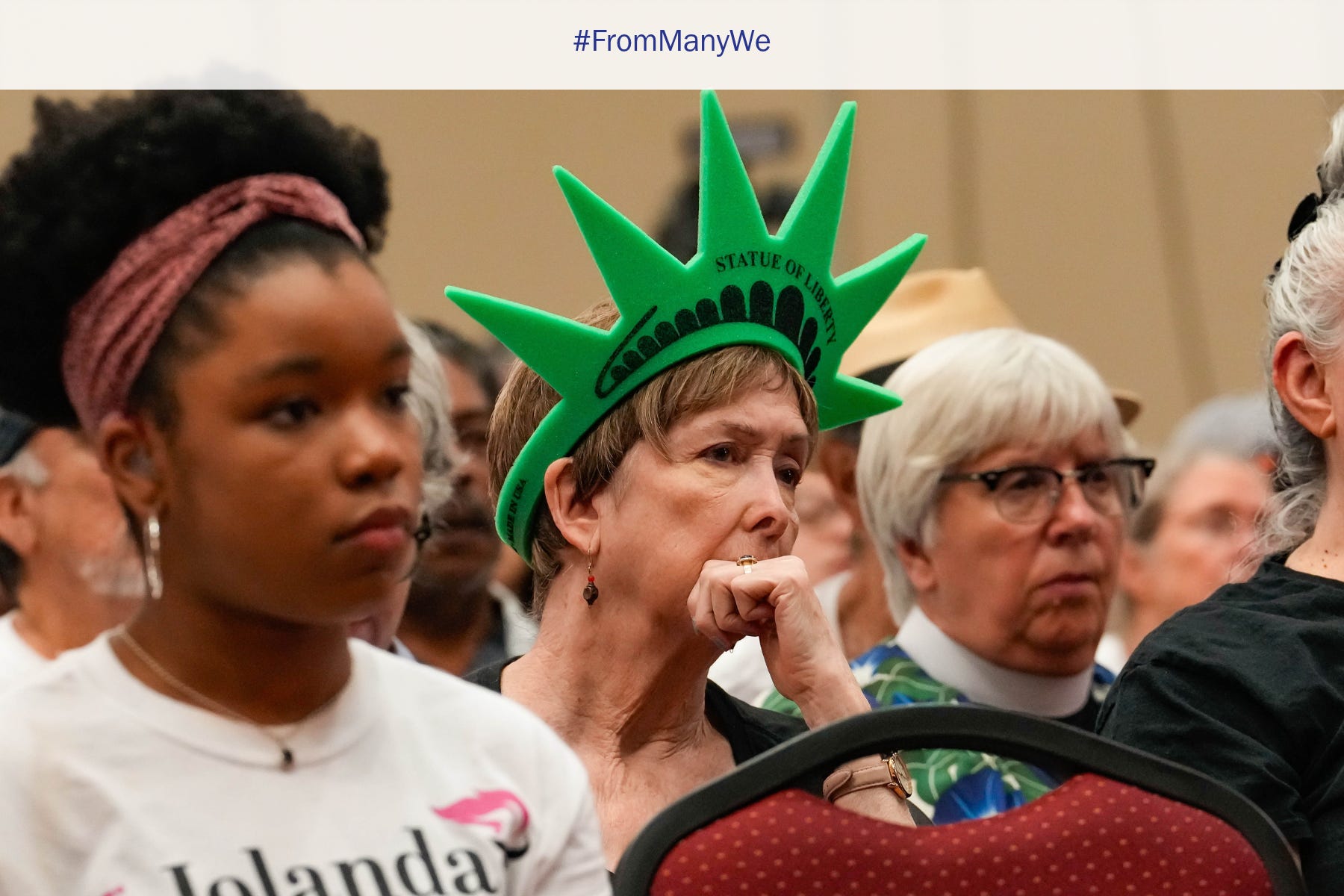
The Democracy for All Project is a multiyear collaboration between the Kettering Foundation and Gallup. This annual survey is based on the responses of more than 20,000 national participants and is designed to understand how Americans experience democracy and to elevate all voices across groups and generations.
The United States of America is one of the world’s oldest and most powerful democracies. Its system of checks and balances, guaranteed through three coequal branches of government and rights enshrined in a written Constitution, have been replicated by countries globally as a blueprint for democracy. Yet, like other democracies, the United States is facing unprecedented challenges from within, as well as from outside actors.
As the US celebrates its 250th anniversary, there is more need than ever before for a timely, independent, and balanced assessment of our most cherished institutions and rights. To meet this need, Freedom House, an organization founded 85 years ago to promote and defend freedom, in partnership with the Kettering Foundation, has created the US Democracy Tracker. The tracker evaluates conditions across eight categories crucial to democracy:
Elections;
Political competition;
Government accountability;
Media;
Freedom of belief, education, and speech;
Organization and assembly;
Access to justice; and
Personal liberty.
Every quarter, using balanced and objective expert analysis, the tracker will identify which of these categories is under the most stress and act as a complement to studies of how Americans themselves experience the rights and institutions to which they are entitled. Together, these paint a more comprehensive picture of the state of US democracy.
The Health of American Democracy
While the tracker utilizes expert analyses, the Kettering Foundation, in partnership with Gallup, has been following the health of US democracy in a different way: by documenting how Americans experience it. The latest results of the Democracy for All Project, an annual survey of more than 20,000 individuals, show a striking overlap with the findings of the first issue of the US Democracy Tracker: ordinary Americans and experts alike are deeply worried about a lack of accountability by elected officials. While the US Democracy Tracker labels government accountability as an issue of serious concern, the Democracy for All Project finds that only 28% of Americans believe that political leaders will be held accountable to the nation’s laws and Constitution.
A government accountable to its people is one of the foundations of a healthy democracy. The institutions that support accountability—such as checks and balances between the executive, legislative, and judicial branches, anticorruption norms, and transparency mechanisms—are simultaneously eroding. And the people’s declining belief in the effectiveness of these institutions is another dangerous warning sign about the durability of American democracy.
According to Freedom House’s Freedom in the World, an annual analysis of political rights and civil liberties of each country and territory throughout the world since 1973, freedom in the United States has declined steadily over the last 20 years. Since 2005, the score for the United States has fallen from 93 to 81 out of 100. The declines have happened under both Democratic and Republican presidential administrations and have been driven by numerous factors, including the growing role of money in politics, increasing obstacles to voting, polarization and concentration of media ownership, partisan pressure on academic freedom and the judicial system, racial discrimination in the criminal justice system, and the curtailing of the rights of immigrants, women, and LGBTQ+ individuals.
Americans appear to be noticing. According to the most recent Democracy for All Project survey results, 56% of those polled think that US democracy is performing poorly or moderately poorly, a small increase from this time last year. Most Americans also believe that US democracy is weaker now than it was 50 years ago and that it will be even weaker over the next 50 years.
A Lack of Accountability Among Those Who Govern America
Public opinion polling tracks closely to expert analysis when it comes to the weak points of US democracy. The first edition of the US Democracy Tracker, which covers developments between July 1 and October 16, 2026, identified government accountability—things like the functionality of government, anticorruption safeguards, and transparency—as a topic of serious concern.
The Kettering-Gallup survey found that 59% of respondents think that the executive branch of the federal government has too much power, and 51% think that the division of power between the three coequal branches of government is working moderately or very poorly. In the tracker, experts highlighted ongoing dysfunction in Congress, marked by its inability to pass most proposed bills and the executive branch’s withholding of funds legally appropriated by Congress. Both factors are evidence of governance marked by executive overreach and legislative ineffectiveness.
The number of Americans who trust that leaders will be held accountable under the nation’s laws and the Constitution has also declined. In 2025, the Kettering-Gallup survey found that 48% of respondents did not agree that leaders would be held accountable, and that figure had grown to 53% by 2026. The sentiment increased across political affiliations, but the most pronounced change was among Republicans. Forty percent of surveyed Republicans disagreed that leaders would be held accountable in 2026, up from 32% the previous year.
Although the survey did not delve into the reasons that Americans are losing trust in the prospect of accountability for their leaders, one driver could be increasing evidence of a disregard for established anticorruption norms. The tracker notes that President Trump, unlike previous presidents, has not voluntarily divested himself of his business interests and has in fact greatly increased his personal wealth while in office. Financial disclosure forms released in July 2026 revealed that his various businesses had generated $2 billion in income during 2025. Many members of Congress also continue to trade stocks despite having access to information that could potentially move the markets. At a time when financial hardship and inequality are prime concerns among Americans, the appearance of corruption or conflicts of interest among elected officials could be exacerbating the public’s negative assessments of government accountability.
Election Concerns and Paths Forward
Despite a generally negative outlook on the quality of democracy in the US today, Americans’ commitment to democracy appears to remain strong. Sixty-six percent of respondents in the Kettering-Gallup poll agree or strongly agree that democracy is the best form of government.
Like the Democracy for All Project, the US Democracy Tracker covers the period before the November 2026 election and therefore does not assess the administration of that election directly. The tracker notes that the electoral framework in the US remains generally fair, but the months leading up to the midterms were marked by attempts by federal authorities to pressure state and local election officials into granting access to voter rolls based on unsubstantiated claims about widespread voting by noncitizens and accusations of election fraud in the 2020 election. These attempts included legal threats by the Department of Justice across all 50 states, a deployment of analysts from the Federal Bureau of Investigation to Fulton Country, Georgia, where there was an earlier raid on an election office, and the seizure of voting machines from Puerto Rico. In addition, the administration tried to change the rules around mail in voting, which was denied by the Supreme Court but only after some states had already started mailing out ballots, heightening concerns about whether absentee ballots would be counted. Americans have taken note of these issues: the Kettering-Gallup poll found that a majority of respondents were concerned that political leaders would pressure election officials to change voting outcomes, ballots would not be properly counted or secured, and voter intimidation would occur near polling places.
In October, scholars Steven Levitsky and Lucan Way argued that abuses of state resources, such as a weaponized Justice Department, pressure on state election officials, and gerrymandering, had pushed the United States into competitive authoritarianism, a regime type that describes political systems in which the incumbent advantage creates free but unfair elections that are difficult or nearly impossible for opposition parties to win. A classic example of a competitive authoritarian regime is Hungary under Prime Minister Viktor Orban.
The sweeping change brought about as a result of the midterms, which flipped control of both the House of Representatives and the Senate from the Republican Party to the Democratic Party, as well as the peaceful and orderly process of the elections, should significantly dampen fears around creeping authoritarianism in the US. The midterms reaffirmed the view of many Americans captured in the Kettering-Gallup polling, that elections are the appropriate democratic lever for political change.
Elections are seismic events in a democracy, but they do not, by themselves, bring about institutional change. As we have seen across other countries with change-making elections this year, from Hungary to Serbia and Brazil, elections are the beginning of a process, not the end. Problems that stem from congressional dysfunction and executive overreach are likely to continue as are the consequences of weakened anticorruption norms. It will be important for all political leaders to address these real concerns moving forward in order to improve governance and to bolster American’s confidence in the nation’s democracy.
Yana Gorokhovskaia is research director for strategy and design at Freedom House and a coauthor of the report Freedom in the World 2026.
From Many, We is a Charles F. Kettering Foundation blog series that highlights the insights of thought leaders dedicated to the idea of inclusive democracy. Queries may be directed to fmw@kettering.org.
The views and opinions expressed by contributors to our digital communications are made independent of their affiliation with the Charles F. Kettering Foundation and without the foundation’s warranty of accuracy, authenticity, or completeness. Such statements do not reflect the views and opinions of the foundation which hereby disclaims liability to any party for direct, indirect, implied, punitive, special, incidental, or other consequential damages that may arise in connection with statements made by a contributor during their association with the foundation or independently.
It's blatantly obvious..