


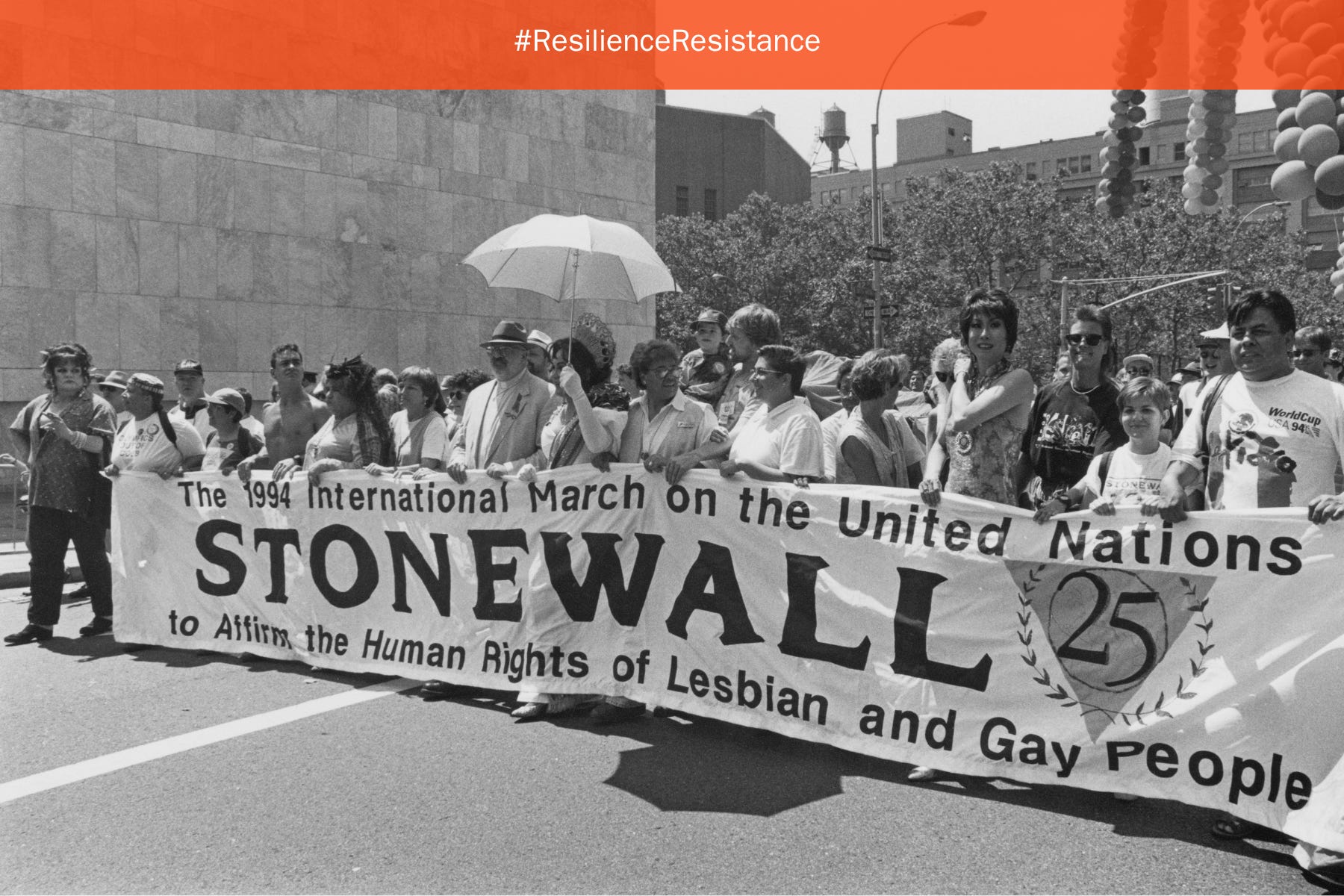
In recent years we have seen a worrying reversal of the advances in LGBTQ+ rights around the world. On the African continent, tough new anti-LGBTQ+ laws have recently been passed in Uganda, Senegal, and Ghana. In the US, there has been an alarming rise in anti-trans rhetoric and harmful policies, like laws restricting access to bathrooms, banning gender-affirming care for minors, and restricting updates to gender markers on official documents, such as passports and driver’s licenses. Most recently in September 2026, the Turkish government’s raids and arrests targeting the LGBTQ+ community made headlines around the world.
These developments should be of concern to everyone concerned about democracy and human rights, even if you are not a member of the LGBTQ+ community. Many of us are familiar with “First They Came,” a poem by Pastor Martin Niemöller, which talks about why we need to speak out when others’ rights are violated, as we might be next. But I want to take this thought a step further: attacks on LGBTQ+ people’s rights are not a precursor for attacks on the rights of others. They are an attack on everyone’s rights and on democracy itself.
Undermining the Rule of Law
As Human Rights Watch points out with respect to the recent crackdown in Turkey, the government’s actions are a threat to the rule of law because many of the activities the targeted organizations are charged with are perfectly legal, such as receiving funds from foreign sources.
More generally, when homosexuality or gender nonconformity is criminalized, it means every person, queer or not, has to watch their behavior to make sure they conform at all times to strict gender stereotypes or risk falling under suspicion. Take, for example the experience of journalist Lydia Polgreen, who was mistaken for a man in a women’s restroom in a hotel in the south of France. Policing and surveillance of some people’s bodies and behavior means the policing and surveillance of everyone’s body and behavior. This is the very definition of an unfree and undemocratic society.
This is not just theoretical. In some cases, such as Uganda’s Anti-Homosexuality Act of 2023, landlords of LGBTQ+ people are at risk of prosecution, as is anyone who does not report a “homosexual act,” including friends and family members of LGBTQ+ people. As a trans man from Montenegro said at a recent meeting I attended, “I don’t like to talk about people being allies. I prefer to talk of accomplices because we are all in this struggle together.”
Attacks on the LGBTQ+ community serve another purpose for anti-democratic actors: they serve as a distraction. In the words of drag queen Jaida Essence Hall, who played a politician during a skit on RuPaul’s Drag Race: “Look over there!” the scapegoating of LGBTQ+ people and other minorities (such as migrants) serves to divert citizens’ attention from authoritarians’ undermining of institutions, erosion of rule of law, corruption, and mismanagement. Turkish activist Yildiz Tar pointed out on Instagram that while the government called its operation “My Family Is Safe,” it is in fact the government’s economic policies that are endangering families, driving them into poverty and increasing economic precarity.
Queer People Have Long Led the Fight
Let us not forget that LGBTQ+ people have been at the forefront of struggles for democracy and civil rights around the world. Trans people led the famous Stonewall riots against police brutality and discrimination in New York City. Bayard Rustin, a gay man, was an advisor to Martin Luther King Jr. and the lead organizer of the March on Washington. In South Africa, Simon Nkoli was one of the Delmas Treason Trialists, jailed for fighting against Apartheid. He is credited with helping the African National Congress realize that any struggle for human rights has to include gay rights. His legacy is one of the reasons South Africa’s constitution protects the rights of LGBTQ+ people. In the UK, the LGBTQ+ community famously came out in support for the Welsh miners’ strike in 1984—a story told in the award-winning 2014 movie Pride.
It is therefore deeply worrying that, as recent reports note, 90% of LGBTQ+ groups have lost funding since the Trump administration dismantled USAID. According to the report, only 3% of the organizations surveyed described themselves as stable. The crisis caused by the USAID cuts has been exacerbated by additional cuts in foreign aid by several other governments and the changing priorities of philanthropic foundations.
Donors who cut funding for LGBTQ+ activists and organizations often argue that the fight for democracy and the rule of law is more urgent than LGBTQ+ rights, but they should know that the two issues are not separate. The fight for LGBTQ+ rights is a fight for the rights of all.
Brett Davidson is founder and principal at Wingseed LLC, and cofounder of the Tindugol Consortium. He works to help social changemakers amplify their impact through storytelling, listening, and narrative change.
Resilience & Resistance is a Charles F. Kettering Foundation blog series that features the insights of thought leaders and practitioners who are working to expand and support inclusive democracies around the globe. Direct any queries to globalteam@kettering.org.
The views and opinions expressed by contributors to our digital communications are made independent of their affiliation with the Charles F. Kettering Foundation and without the foundation’s warranty of accuracy, authenticity, or completeness. Such statements do not reflect the views and opinions of the foundation which hereby disclaims liability to any party for direct, indirect, implied, punitive, special, incidental, or other consequential damages that may arise in connection with statements made by a contributor during their association with the foundation or independently.