

The Democracy for All Project is a multiyear collaboration between the Kettering Foundation and Gallup. This annual survey is based on the responses of more than 20,000 national participants and is designed to understand how Americans experience democracy and to elevate all voices across groups and generations.
The degree to which citizens participate in civic and political activities is one of the most common indicators used to measure the vitality of a democracy. In societies where citizens regularly engage in their communities, there is often greater collective trust and greater tolerance of those who hold differing political opinions. Since its founding 250 years ago, the United States has been celebrated as a strong democracy in which citizens participate in various forms of civic life, from community service to political advocacy. In recent decades, however, research has documented how participation and engagement have waned and is plagued by inequality among different demographic groups. As the nation moves into the next 250 years, it is an important time to reflect on the ways that Americans are currently engaging in our democracy and the issues that motivate them to participate in fulfilling its promise.
The State of Civic Participation in America
In the 2026 wave of data collection, the Democracy for All Project, a multiyear collaboration between the Kettering Foundation and Gallup, provides important insights into who is participating in our democracy today and what motivates them to get involved. The data show clear evidence that online engagement in politics is increasingly a key hub of socialization and democratic practice. Forty percent of the adult Americans surveyed reported having posted their opinions about politics online in the past year and about a third (32%) reported that they had participated in online social platforms—such as Facebook groups, Nextdoor groups, or similar forums—to discuss issues facing their communities.
Participation in face-to-face activities was more varied. Almost a third (32%) of respondents said they had volunteered for or participated in organizations designed to improve their communities in the past year, and an additional 38% said they wanted to participate in such organizations but had not done so. Overall, these data suggest that America continues to be a nation of civically engaged “joiners,” even though “joining” for many has become an online activity.
The survey also asked American adults if they had participated in a protest, rally, or demonstration in the past year. Although there are various ways that citizens engage to express their dissatisfaction with a regime or to encourage specific policies, one of the most common and visible tactics is through peaceful protest, which includes public demonstrations, rallies, and marches.
Sixteen percent of American adults in the Kettering-Gallup survey reported participating in protest, and an additional 28% reported wanting to participate.
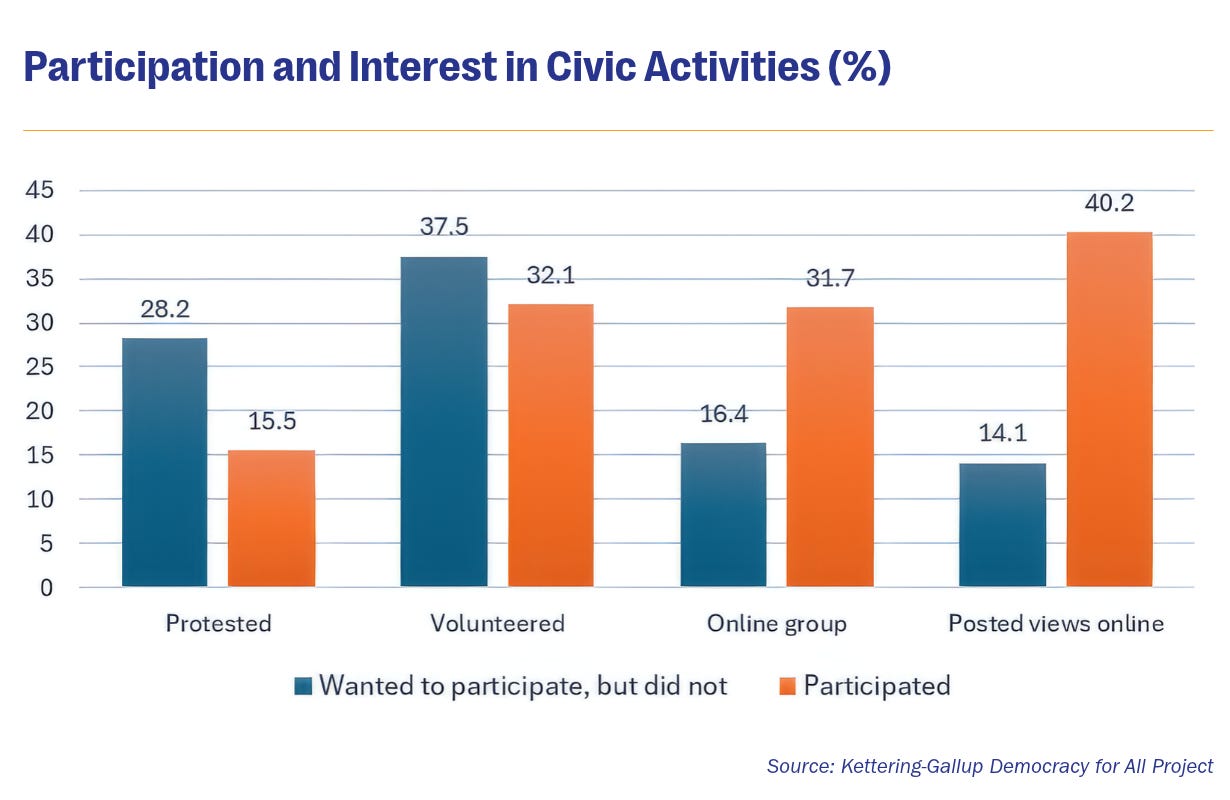
These statistics are particularly notable since they indicate an increase in protest participation. For example, in April 2018, the Washington Post-Kaiser Family Foundation conducted a survey of American adults and asked who had participated in a protest, march, or demonstration since the first Trump administration had taken office in January 2016. At that time, 12% of American adults reported having participated during this period of time, which is a lower rate than we see today.
Understanding Protest Participation
The Democracy for All Project also provides important details about who is participating in protest in the current historic moment.
Education Level
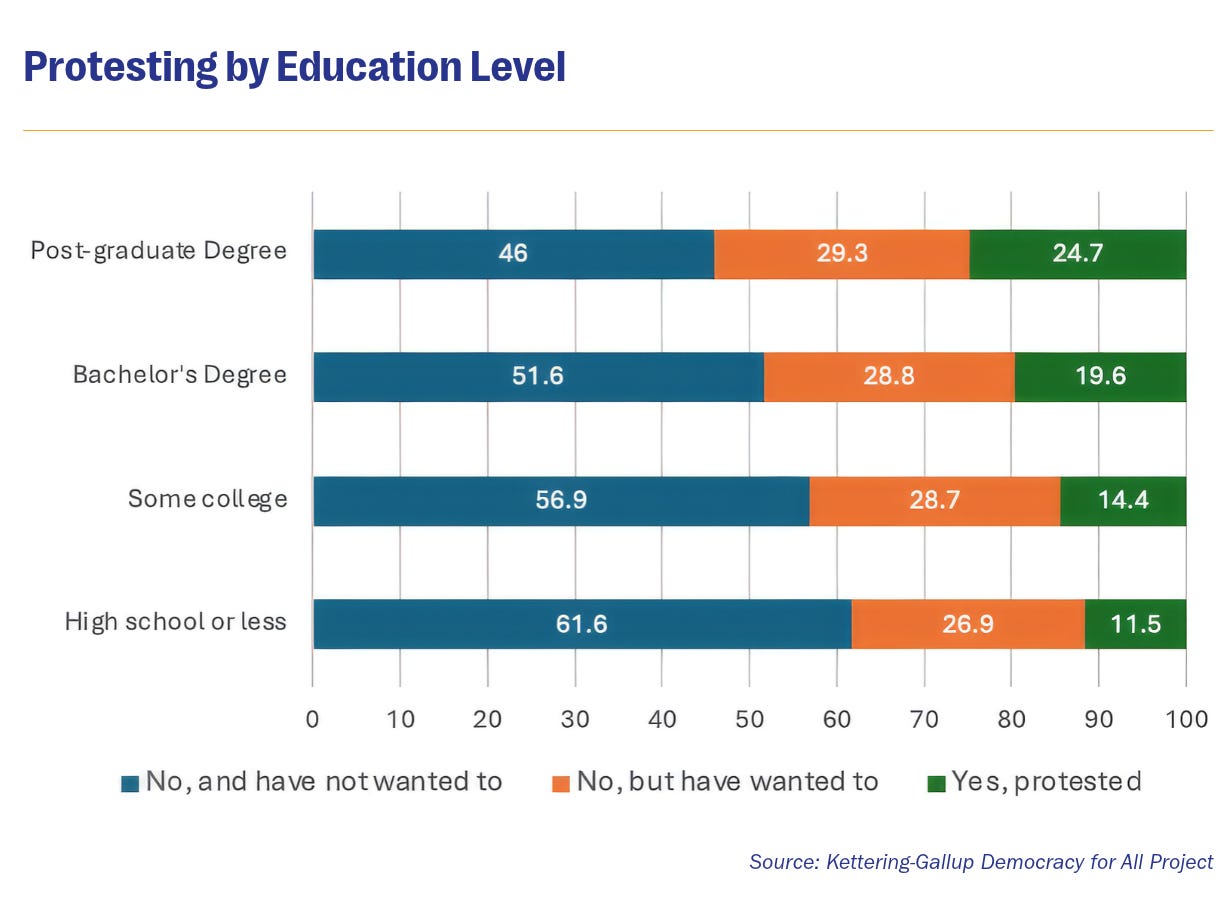
According to decades of social scientific research, protesters have a consistent demographic profile: they tend to be highly educated, politically left-leaning, and young. Data collected by the Democracy for All Project finds similar patterns for American adults in 2026. Those who had protested in the past year were more highly educated. Respondents with the highest levels of educational attainment, a post-graduate degree, were the most likely to report having protested (25%) or wanting to protest (29%), and those with a high school degree or less were the least likely to have participated (12%) or to have wanted to protest (27%).
Also consistent with the expectations from previous research on protest participation, American adults in the Democracy for All Project who identified as being left-leaning were much more likely to have participated in protest in the past year. Almost a quarter of Democrats or Democrat-leaning independents reported having protested in the past year (23%). The statistic was much lower for those who identified as Republican or Republican-leaning independents (9%).
Age
This new data also supports previous findings that younger people are more likely to protest than elders. Youth are not only in the formative years of their lives, developing and experimenting with their social and political worldviews, but also have what scholars call “biographical availability.” In other words, younger people have fewer family and work obligations that would limit their ability to participate in a protest on a weekend or an evening. Moreover, a sizable share of young adults are also students on university campuses where political activism has historically flourished.
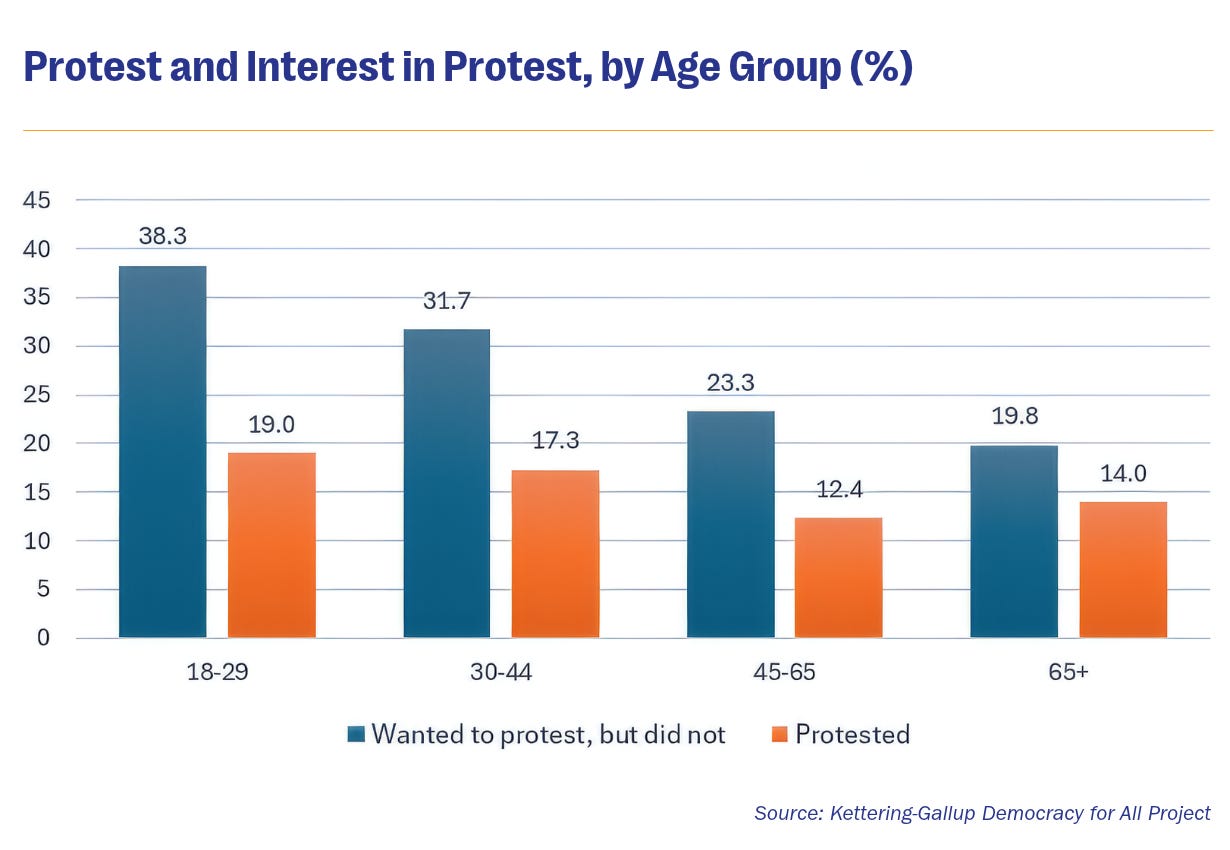
When we look at the data from the Democracy for All Project across age categories, there is an association between age and levels of participation in protest. While 19% of those aged 18–29 had protested in the past year, only 17% of those aged 30–44 and 12% of those aged 45–64 had protested. However, the rate goes back up for people in the oldest category of 65 years old and over. For this group, which includes many Americans who have retired and are more biographically available, 14% reported having protested in the past year.
Although these gaps are not remarkably large, the differences swell when we consider those people who expressed interest in protest. Specifically, an additional 38% of those aged 18–29 said they wanted to participate in protest in the past year but had not done so. These figures progressively fall among each age bracket: 32% of those aged 30–44, 23% of those age 45–64, and 20% of those aged 65 and over claimed they had wanted to protest but had not done so. This finding suggests that the greatest potential for more people to participate in protest is among young people, many of whom reported being interested in protest despite not participating.
Race and Party Identification
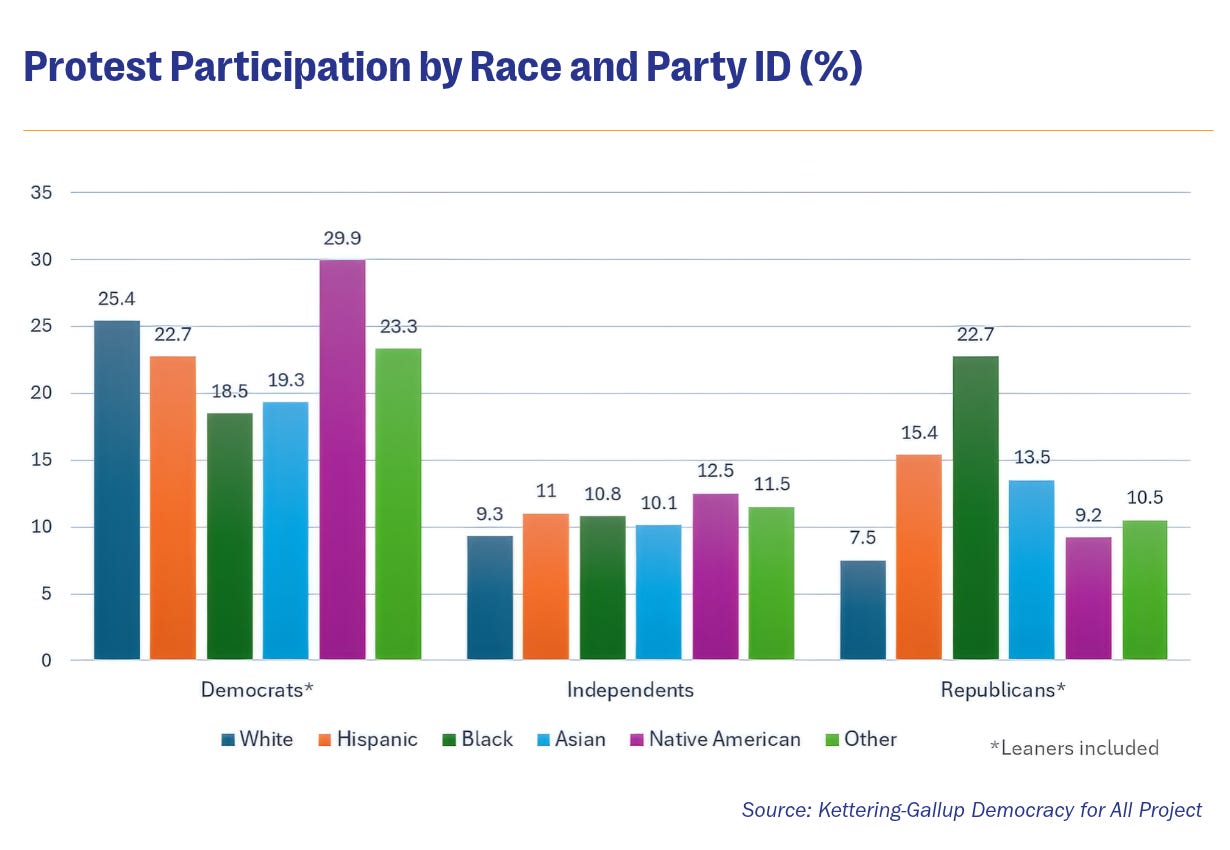
While the trends noted above align with existing academic knowledge about protest participants, the Democracy for All Project also presents some fascinating new findings regarding protest patterns based on party identification and how it interacts with racial identities. Overall, the data show that people of color reported participating in protest at slightly higher rates than White individuals (17% versus 15%).
When we look at how racial dynamics are related to party affiliation, there are clear differences. Among Democrats, White individuals are the most active: 25% of White Democrats reported protesting in the past year compared to 19% of Black Democrats, 19% of Asian Democrats, and 23% of Hispanic Democrats. Democrats that identified as American Indian or Alaska Native had the highest rates of protest at 30%. Among Republicans, though, Whites were the least engaged in protest. While only 8% of White Republicans reported participating in protests in the past year, the rate of protest for Black Republicans was nearly three times greater than White Republicans: 23% of Republicans that identified as Asian and Hispanic also reported protesting at much higher rates than their White counterparts (15% and 14%, respectively). Among independents who did not report leaning toward either party, protest rates were fairly similar among all races.
In sum, although party identification plays a more significant role in explaining protest participation, these findings show how the racial dynamics of protest differ substantially between the two major parties: Democrats that join protests are more likely to be White, on average, while Republicans that protest are more often people of color.
No Kings Participants and Differences Across Movements
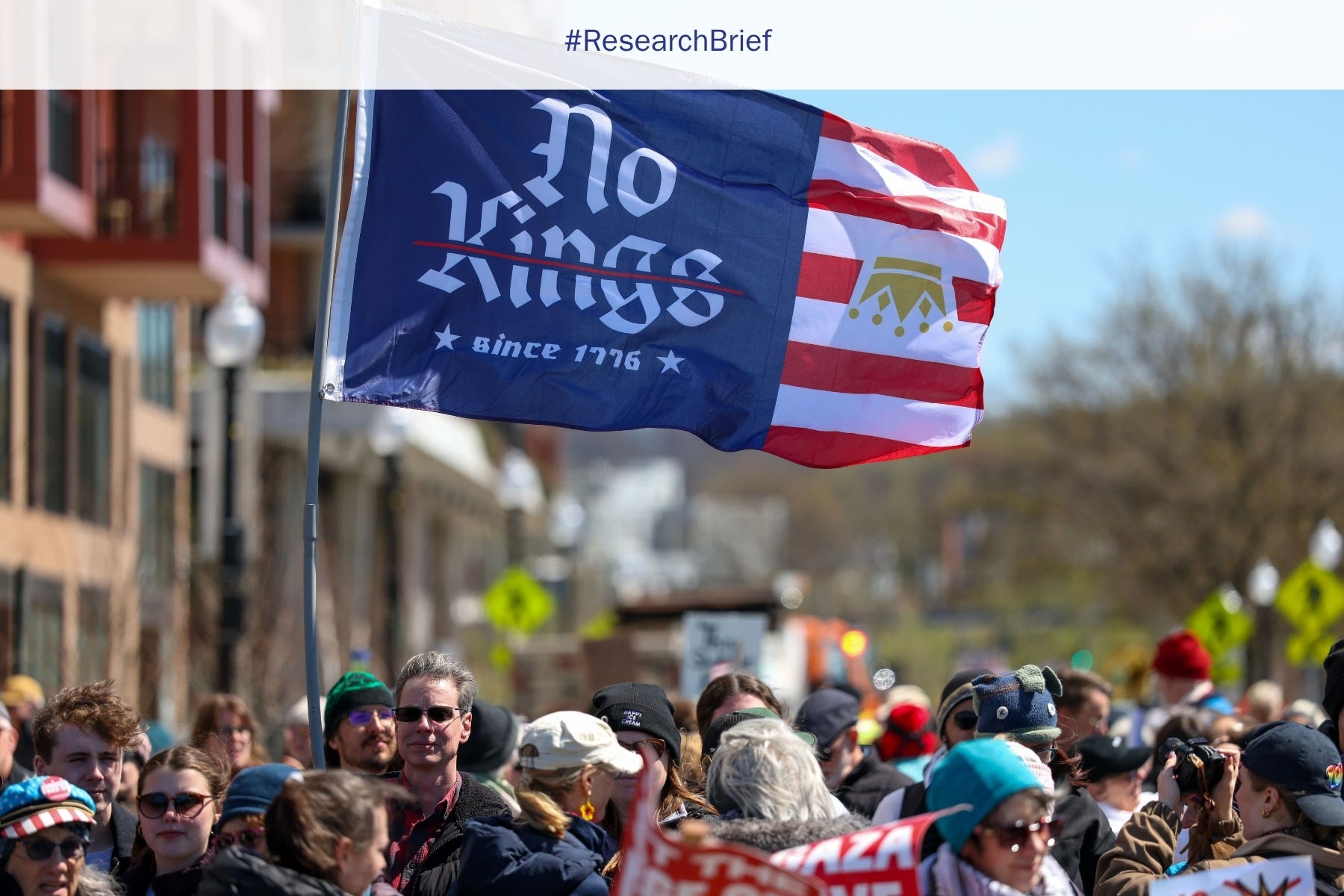
As part of an ongoing research project studying protest participation in America, our research team at American University has been studying protesters who have mobilized to participate in the largest days of action during the second Trump Administration: the nationwide No Kings protests. Rather than collecting data from a national sample of American adults, like the Democracy for All Project did, this project collects data directly from protest participants, in many cases while they are marching in the streets or listening to speeches at a rally. By directly surveying protest participants while they are protesting, we can collect more granular data on this particular group of people to understand their beliefs, motivations, and backgrounds. Comparison to the Democracy for All Project sample reveals which groups are under-represented in the No Kings protests.
Our data collected from protesters at No Kings days of action were somewhat consistent with the data from the Democracy for All Project. Participants in these anti-Trump rallies were highly educated (87% of protesters had a bachelor’s degree or higher) and were left-leaning. At every event, over 92% of participants reported having voted for Democratic candidate Kamala Harris for president in 2024.
At the same time, the data we collected from No Kings participants were also quite different. Participants were predominantly White (84%) and middle-aged (the average age across all of our samples was 45). Since nearly all of the No Kings participants supported the Democratic Party in the 2024 election, it is not surprising to see that our findings are congruent with the racial dynamic discussed earlier: among Democrats, it is predominantly White people taking to the streets to protest.
While the Democracy for All Project data show that young people aged 18–29 were most likely to participate in protests in the past year, the data we collected from the No Kings rallies document that young people have not been participating at high rates in these protests against the Trump administration and its policies. In other words, young people are protesting, but they are largely channeling their activism into other events aside from the major mobilizations of the current pro-democracy movement.
Citizen Responsibility
The Democracy for All Project also asked respondents what they considered to be the most important citizen responsibility right now: either “speaking up against injustice” or “respecting authority.” In our analysis, the key feature separating respondents on this question was political affiliation. Overall, most respondents selected “speaking up against injustice” (70%). Among Democrats in the sample, 84% supported this statement compared to only 49% of Republicans.
Once again, we find interesting differences when we look at these data across party identification and protest experience. Those who have protested in the past year, no matter their party identification, supported speaking up more. While support for speaking up against injustice was high for Democrats overall whether they protested or not (87% versus 84%, respectively), the findings were different for Republicans. Although Republicans generally supported speaking up less, the rate was higher for those Republicans who reported participating in a protest over the past year (56% versus 49% for Republicans who did not protest).
Motivations
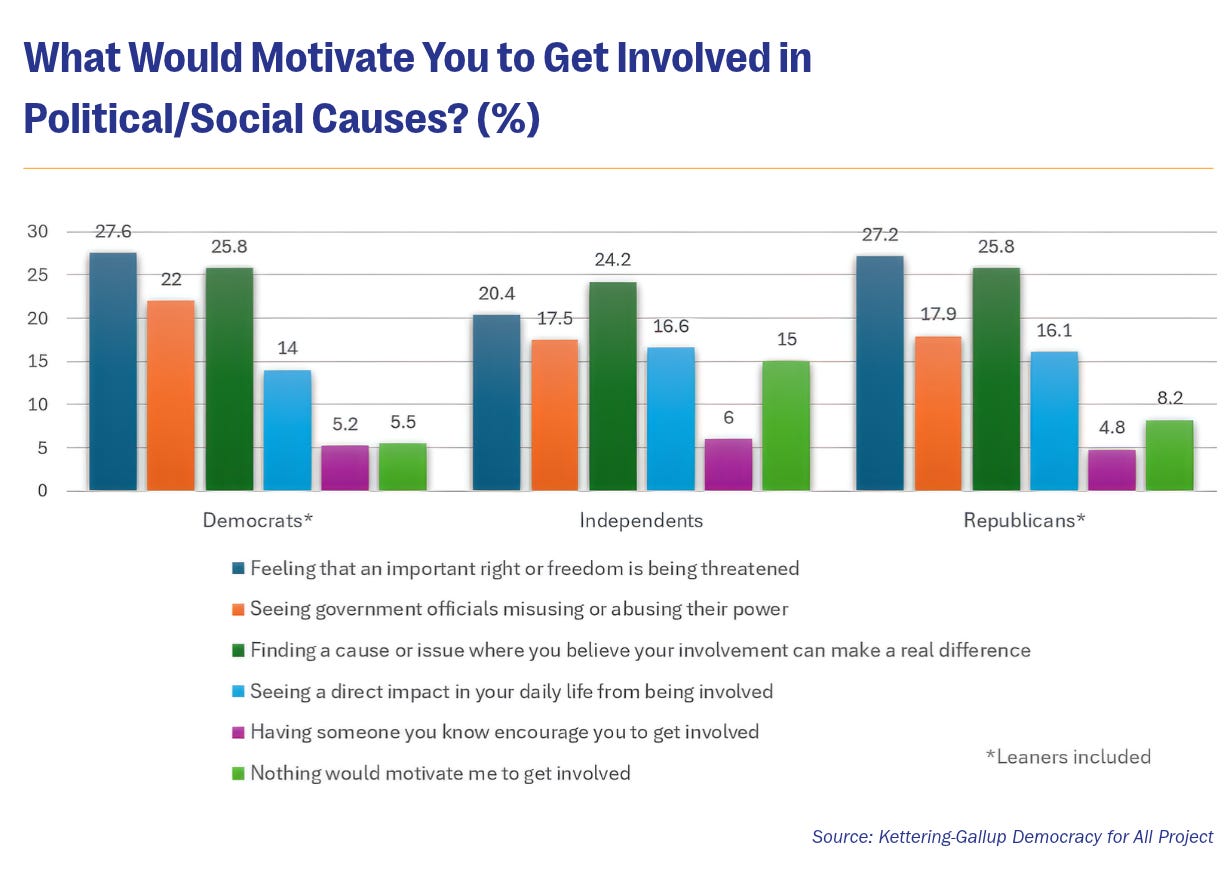
The Democracy for All Project also explores what would motivate Americans to get involved in a political or social cause. The data show remarkable consistency for respondents, no matter their political party affiliation. The most common response overall was “feeling that an important right or freedom is being threatened,” which was selected by 28% of Democrats, 27% of Republicans, and 20% of independents. Among independents, the most common answer selected was “finding a cause or issue where you believe your involvement can make a real difference.”
The biggest differences across motivations can be seen in responses to the category of being motivated by government officials abusing power. From a list of possible motivations, this option was selected by 22% of Democrats in contrast to 18% for both independents and Republicans. Beyond that difference, independents are more likely to be motivated by seeing a direct impact on their daily lives (17% versus 16% for Republicans and 14% for Democrats). Independents are also most likely to report that nothing would motivate them to get involved (15% versus 8% for Republicans and 6% for Democrats). Although this finding is the most notable, it is important to stress that it only pertains to a small percentage of independents overall.
Reframing Protests for Democracy
As the United States celebrates the 250th anniversary of its founding, the Democracy for All Project documents a significant number of Americans are still participating in civic and political activities. However, it also shows how much of this participation has been redirected from face-to-face interactions to online activities. Significant demographic traits continue to separate those who join one of the most active forms of participation—protest—and those who sit out. Americans who join protests, including those participating in the massive, nationwide No Kings days of action, have very high levels of educational attainment compared to the national population and largely affiliate themselves with the Democratic Party. Moreover, despite the No Kings rallies attracting mostly middle-aged and older individuals, young Americans are not checking out of political activism. In fact, the Democracy for All Project’s data reveal that the youngest Americans report joining protests at higher rates than middle-aged and older adults. These findings indicate that young people are devoting their political involvement to causes beyond the large-scale and nationally coordinated No Kings mobilizations.
In other words, the No Kings rallies, which have been organized to defend democracy and combat authoritarianism, are more resonant with middle-aged and older generations. Recently, public polling has confirmed that young Americans are more disillusioned with democracy and experience deeper economic insecurity than their elders. It is not entirely surprising then that younger Americans are not showing up to defend a system that they feel never worked for them. Instead, they are likely more interested in deeper, structural change rather than preserving existing institutions and systems. As the Democracy for All Project shows, young Americans report joining protests at high rates. The data we have collected from protest participants document how younger Americans tend to prioritize other issues, such as opposition to the war in Gaza and racial justice. One strategy for channeling more young people into the pro-democracy movement would involve connecting pro-democracy sentiment with efforts toward more robust socioeconomic and political changes in America.
In recent years, social science research has emphasized the centrality of political polarization in US politics. Inter-party hostility has increased, and Democrats and Republicans increasingly feel more negative toward one another. Data collected from the Democracy for All Project affirms that citizen priorities are significantly different for people who affiliate with the two main political parties. The data also reveal that the partisanship divide shapes patterns of civic engagement in America today. Democrats not only protest far more than Republicans but also the demographic makeup of protesters within each party differs significantly. At the same time, there are very clear similarities in motivations to act across party identification. Those who are looking to mobilize more Americans to participate in face-to-face forms of activism would benefit from connecting their efforts to feelings that important rights or freedoms are being threatened.
Dana R. Fisher is the director of the Center for Environment, Community, & Equity and a professor in the School of International Service at American University.
Arman Azedi is a postdoctoral fellow at the Center for Environment, Community, & Equity at American University.
The views and opinions expressed by contributors to our digital communications are made independent of their affiliation with the Charles F. Kettering Foundation and without the foundation’s warranty of accuracy, authenticity, or completeness. Such statements do not reflect the views and opinions of the foundation which hereby disclaims liability to any party for direct, indirect, implied, punitive, special, incidental, or other consequential damages that may arise in connection with statements made by a contributor during their association with the foundation or independently.