

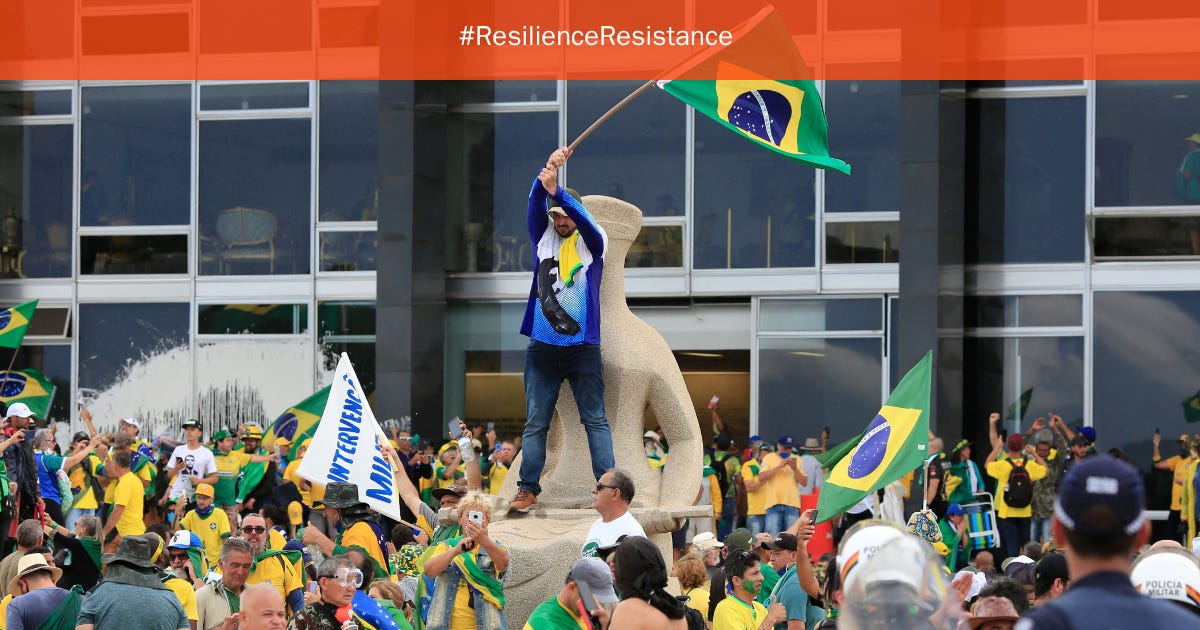
Brazil and the United States are sharing similar challenges at this point in time: important upcoming elections, democratic governments at risk, and a past that is very present. Both are countries that were built through the labor and struggles of their people, with many racialized groups still being excluded from the benefits of democracy. Racism, violence, and deep social inequality are structural issues in both countries, while recent years have also seen parallel challenges to democratic systems and rule of law.
With such similar contexts, the United States and Brazil can learn from each other. Each country has had to address recent attacks to their democracies while also building strategies to defend democracy and human rights. Sharing concerns and strengthening relationship ties are very important in today’s political climate.
In Brazil’s case, the upcoming October presidential election will determine if a democracy that is under attack from both internal and external interference can be protected. November’s midterm elections in the US carry a similar need for protection, though the threats against the electoral system are mostly from internal forces.
Two Democracies, Two Different Responses
After losing their reelections, both Donald Trump in the US and Jair Bolsonaro in Brazil challenged the electoral outcomes. Even without evidence of wrongdoing, both former leaders refused to accept the election results and incited violence. In the US, this culminated in the attack on the Capitol on January 6, 2021. In Brazil, the violence incited the invasion of Congress, the Supreme Court, and the presidential palace on January 8, 2023. The attacks were strikingly similar too: mobs—instigated by the former leaders—stormed the heart of government, smashed windows, destroyed offices, and clashed with security forces.
But the judicial and societal responses were quite different.
In the US, Trump was not held accountable through a criminal trial and has returned to power. Since returning to office, he has issued full and unconditional pardons to all January 6 rioters, including those who used violence against law enforcement officers and desecrated the Capitol. Furthermore, many members of Congress have continued to support Trump and denied that the events on January 6 were an attempted coup.
In Brazil, on the other hand, after a two-year investigation, the Supreme Federal Court sentenced Bolsonaro to 27 years and 3 months in prison for conspiring to overturn the 2022 election. The attempted coup was investigated and adjudicated by the judiciary in accordance with constitutional guarantees of due process. Brazil’s response reflects a robust institutional backlash to the assault on democratic norms and the rule of law. Before this criminal conviction was handed down, Bolsonaro was barred from running for office for eight years due to a previous ruling for abuse of political and economic power. He is now under house arrest.
The Upcoming Election in Brazil
Protecting Brazil’s democracy in 2026 will require not only safeguarding the electoral process itself but also ensuring there is a coordinated effort to strengthen democracy. To prepare, the country’s civil society organizations have been building their alliances with human rights and democracy organizations to be able to fight for the integrity of the 2026 presidential elections and protect Brazil’s democratic institutions.
Conectas—a nonpartisan international NGO founded in Brazil to promote human rights from a global south perspective—has, along with partners, been defending electoral integrity and strengthening democratic institutions. We have joined efforts to engage in dialogue with public authorities and the international community, including US organizations, to defend the institutions that safeguard Brazil’s democratic system. We are connecting to protect the fairness, transparency, and equal conditions for all candidates in the electoral process.
These civil society organizations also recognize that the country’s future could consist of a more anti-rights Congress. For this reason, there is also a coalition of organizations discussing which human rights policies should be protected from potential setbacks.
Concerns About US Interference
US interference in the Brazilian election and in its democratic processes has become a significant concern. The Trump administration has undertaken a series of troubling actions aimed at the Brazilian judiciary, including visa restrictions on justices of the Brazilian Supreme Federal Court and other Brazilian authorities and sanctions against a sitting justice of the Supreme Federal Court. Widely regarded as unprecedented, these actions have been sharply criticized by scholars and practitioners, such as the New York City Bar Association and the Vance Center for International Justice.
The current administration has also imposed tariffs on Brazil and launched a Section 301 investigation, explicitly linking the measures to Brazil’s judicial handling of their attempted coup, decisions involving digital platforms, and the regulation of major technology companies.
In May of 2026, the US Department of State classified two Brazilian criminal organizations as foreign terrorist organizations. This is particularly concerning because it introduces the possibility of political and military intervention by the United States. It also raises concerns about how social movements, NGOs, and residents of communities affected by organized crime could become targets of persecution.
Lessons Learned, Lessons to Share
From what we have learned during the previous federal government in Brazil, the 2022 elections, and the preparation for this year’s elections, we have some recommendations for US-based pro-democracy organizations.
Understand the seriousness of the current US context and impact to the region. One of the most important things is to understand the severity of the situation in the US. By recognizing it as an authoritarian government, the strategies to be used should consider the danger and impacts of actions to be taken. While US-based democracy organizations must focus on defending democracy, they also need to work to envision and expand democratic practices so they are more inclusive and effective for all people.
Map vulnerabilities and be prepared for retaliation. During Bolsonaro’s government, engagement in decision-making spaces was accompanied by institutional measures to protect the organization. Conectas mapped physical, digital, legal, and well-being risks, strengthening our resilience, especially during the 2022 elections. While remaining nonpartisan, we joined a broad coalition defending democracy.
Find opportunities for both national and international solidarity. Supporting the people and groups most affected by democratic backsliding was central to our strategy. We provided legal and other forms of protection while strengthening coordination with civil society partners and social movements, both in Brazil and beyond its borders. Building broad and unique alliances is essential to strengthening democracy. At Conectas, diversifying institutional partnerships proved highly effective. During the COVID-19 pandemic, our collaboration with Center for Research in Health Law at the University of São Paulo (Cepedisa/USP) produced the Rights in the Pandemic bulletin, which became a key reference for the Parliamentary Commission of Inquiry into the federal government’s response. We partnered with digital rights organizations to bridge traditional human rights agendas with emerging digital challenges and to strengthen democratic resilience. We also strengthened our commitment and strategies to fight racism and other inequalities. Furthermore, we have been promoting sustained exchanges between Brazilian and US organizations to share strategies, deepen contextual understanding, and strengthen joint action in defense of democracy and human rights. This is an ongoing project we have with the Kettering Foundation and The Horizons Project, which has opened many doors for collaboration.
Protect what has already been achieved. It is essential to safeguard historic achievements and defend democratic institutions, while recognizing their limitations and structural problems. Some of these safeguards are already being attacked. It is important to remember that US birthright citizenship and other constitutional rights were already under attack during the first Trump administration, just as they had been under Bolsonaro.
Document and denounce violations. Collect information and data on the government’s destruction and violation of rights and policies. When possible and necessary, carry out national and international strategic litigation and advocacy efforts. Finally, try to pair these actions with communication strategies that will inform the population, pressure decision-making actors, and help get more overall support. Whenever possible, do this work in partnership with other organizations because this distributes risk and responsibilities.
Find the appropriate institutional strategy. Because Brazil’s judiciary was one of the few remaining checks on democratic backsliding, strategic litigation became a key tool in defending Brazilian democracy and human rights during Bolsonaro’s government. International advocacy also proved essential, which suggests that US civil society could benefit from strengthening global partnerships and using international forums to expose democratic and human rights violations.
Focus on your country but don’t disconnect from the rest of the world. While Brazil’s democracy and human rights crisis demanded most of our attention, it also reinforced the importance of maintaining international engagement. We strengthened exchanges with organizations across the global south, showing that even during domestic crises, sustaining international solidarity and shared learning is essential.
Looking Ahead
Protecting democracy in current times requires not only safeguarding electoral processes but also ensuring a coordinated effort to strengthen democratic institutions and human rights and fight racism and other inequalities in order to be able to provide a strong response when rights are challenged.
Despite all the challenges faced by Brazil, one of the most encouraging developments has been the continued public trust in its secure, transparent, and internationally recognized electoral system. The 2022 presidential elections reaffirmed the reliability of electronic voting, with the international recognition of the results reinforcing confidence in a system repeatedly validated by international observers. We hope public trust remains high as we look ahead to the upcoming elections in both Brazil and the United States.
Julia Neiva, a 2026 CFK Global Fellow, is a cofounder and the deputy director of Conectas Direitos Humanos in Brazil.
Resilience & Resistance is a Charles F. Kettering Foundation blog series that features the insights of thought leaders and practitioners who are working to expand and support inclusive democracies around the globe. Direct any queries to globalteam@kettering.org.
The views and opinions expressed by contributors to our digital communications are made independent of their affiliation with the Charles F. Kettering Foundation and without the foundation’s warranty of accuracy, authenticity, or completeness. Such statements do not reflect the views and opinions of the foundation which hereby disclaims liability to any party for direct, indirect, implied, punitive, special, incidental, or other consequential damages that may arise in connection with statements made by a contributor during their association with the foundation or independently.