

There is a region in Brazil that brings together Recife and Olinda, two major cities in the state of Pernambuco, where part of my mother’s family comes from. People in this region are famous for a megalomaniacal view of whatever happens on their turf. They like to describe local events as something unique: the biggest and best in Brazil, maybe in the world. Be it Carnival or the story from Olinda of the first McDonald’s in the world to go out of business. This is not just my impression. Pernambuco filmmaker Douglas Henrique documented the McDonald’s story in his short film Olinda’s Golden Arches, which ties the restaurant’s closing to the city’s political rivalries after Brazil’s return to democracy.
After Brazil’s presidential runoff, on October 25, 2026, I realized they may not be so megalomaniacal after all.
On October 4, 2026, President Luiz Inácio Lula da Silva (“Lula”) finished the first round of the presidential election 2.2 million votes behind Flávio Bolsonaro, the former president’s son. That same day, Bolsonaro’s far-right Liberal Party won 19 Senate seats, bringing the party’s total to 28, the largest delegation any single party has ever held in the Brazilian Senate, plus 121 seats in the Chamber of Deputies, the largest in the lower house. Two days later, Bolsonaro announced he would use those majorities to “change the Constitution” and “re-democratize this country.”
The 1988 Constitution is the cornerstone of Brazil’s return to democracy, written after 21 years of military dictatorship. Hearing a candidate promise to tamper with it reminded many of us of Jair Bolsonaro’s government, which ruled through what has come to be called “authoritarian infralegalism,” bypassing Congress with decrees, appointments, and administrative pressure. With Flávio Bolsonaro in power under these conditions, those tactics would not even be necessary. With majorities in both houses, he could rewrite the rules themselves. Gradually, defending democracy took on unprecedented importance, and the question changed: Would whoever won still be subject to checks and balances? Bolsonaro, a candidate who launched his campaign alongside Javier Milei, received praise from Benjamin Netanyahu, and whose family has close ties to Donald Trump’s administration had already made clear what he meant by “re-democratizing” the country.
An Important Lesson
Many Brazilians came out of the first round of elections terrified. Between the promise to change the Constitution and the promise to create a “Ministry of Prosperity,” we came to understand that a democratic future is never guaranteed. It has to be chosen every day. What a relief to realize this while there was still time to choose at the ballot box. Elections are the heart of this machinery. One thing worth remembering about populist and autocratic movements is that they rise through legal means, through free and direct elections, yet they always try to discredit the electoral process and the electoral courts, even when they win. When they lose, their attacks on democratic institutions grow even fiercer.
In those weeks between election rounds, our greatest examples of resilience were our elders. It may sound like a cliché, but one of our greatest assets in getting people to the polls and fighting the abstention that had been so high in the first round were members of the older generation. These were the people who witnessed the street protests for direct elections in the middle of the dictatorship, who experienced the Diretas Já movement of 1983 and 1984, and who went on to build the institutions for the world we grew up in.
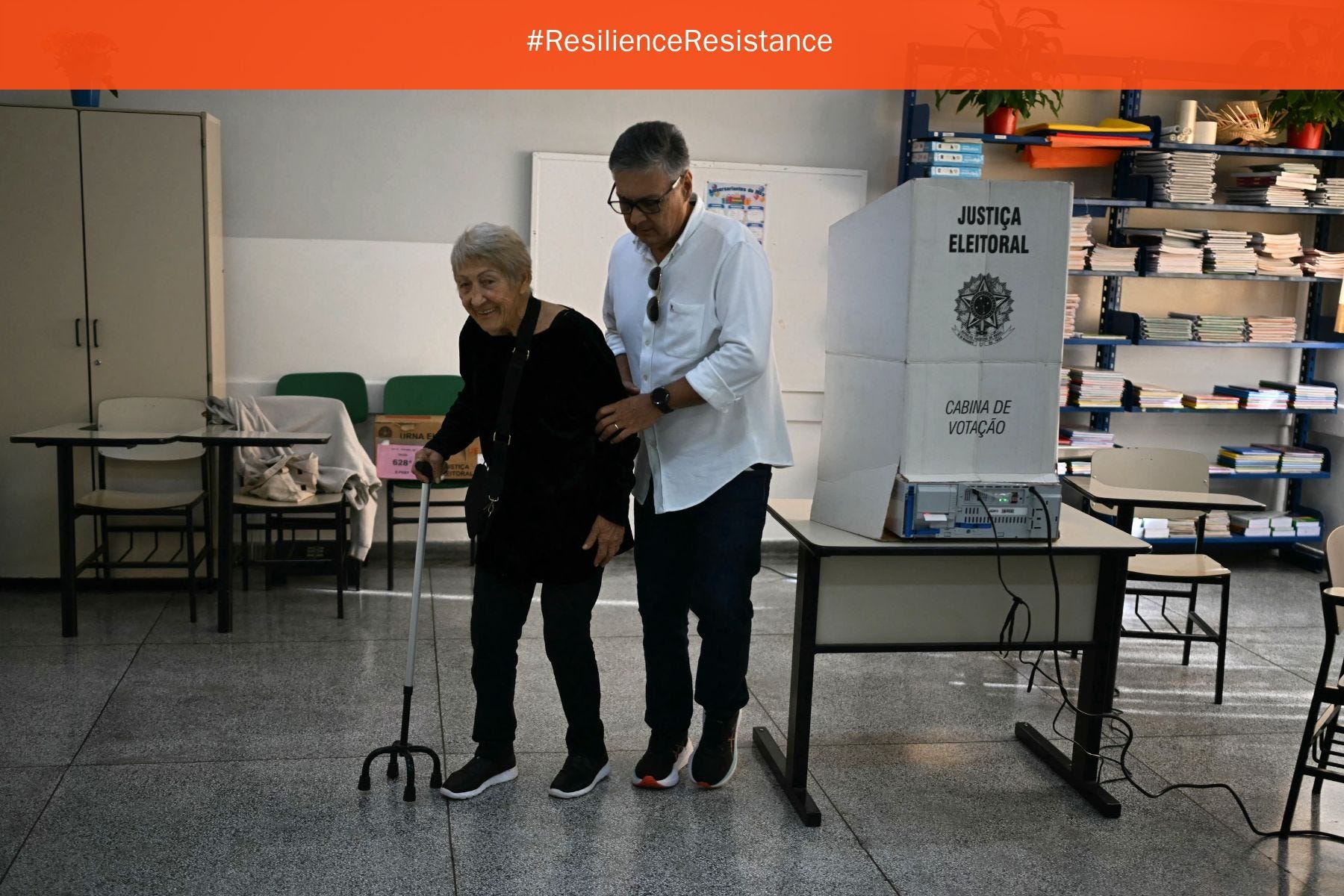
Nothing was more natural than an alliance between those who will live this future and those who left us this legacy of institutional struggle. Young people, digital natives, organized and spread the call. Within days, huge rallies spread across the country in city centers and on the outskirts. The day after the first round, students at Fluminense Federal University took to the streets of Niterói, across the bay from Rio de Janeiro; their energy spread throughout Brazil. On election day, elderly people went to vote in wheelchairs, under the most difficult conditions, even though voting in Brazil becomes optional at 70. These elders showed the young the simplest and most extraordinary thing about democracy: everyone’s vote counts, and counts the same. Democracy is an alliance between different people, in which each person understands their role, their contribution, and their duty.
It would not be fair to talk about the young and the old without recognizing the tireless work of Brazilian journalists and how much knowledge they produced to fight disinformation. This blog post is, in fact, an attempt to spread the hope they gave us around the world: with dialogue and good sources, it is possible to turn things around.
And that is how, on October 25, Lula won the runoff with 64.3 million votes, more than any presidential candidate in Brazilian history. He gained 10.4 million votes between the two rounds, with roughly three out of every four new votes going to him.
Lula won, but the real giant to emerge from this process was Brazil. We understood once again the strength of an election with a broad debate of ideas and competing political projects. And we took care of it. We kept an eye on the electoral courts, defended equal treatment for every vote and every candidate, and watched our institutions work. The democratic process came out stronger.
Born from This Ground
Being part of all this, I understood something that citizens of Recife and Olinda have always known. When someone from Pernambuco says they have the biggest Carnival in the world, they are measuring themselves by their own standard. Biggest, there, means “unique”: born from that ground and no other.
For a long time, we learned the colonial grammar in institutional politics too. The great democracies were supposed to be those of the global north. Our job was to import their models and their architecture. In these weeks, Brazil did something different. It revisited its own history (the dictatorship, Diretas Já, the 1988 Constitution, the years of infralegalism) and reinvented what defending democracy means: protecting the Constitution that gave us back the vote, keeping checks and balances on whoever governs, occupying the streets and social media, bringing generations together, watching over every step of the election. The word democracy stopped floating in the air in empty debates and took on a body. The freedom we sought was different from the founding principles of Western modernity. It was the freedom of self-determination, of being who we are from our own will, our own land, our own dreams, without depending on being seen, or singled out, from the outside.
So I say this with all the megalomania of Pernambuco: we are the greatest democracy in the world. The greatest because it is the only one born here, from a people who decided that every vote is worth the same and rushed to fight abstention, which restored some faith in, and desire for, the democratic act of choosing.
We made it happen because we decided we are too big to fit in anyone’s backyard, and that is not only about our relationship with other countries. Brazil is also too big to fit into narratives from the wealthy regions in the Southeast and the South about who knows how to vote, who votes better, or which regions of this continent-sized country are supposedly settling for crumbs. The ballot box follows no compass; it points neither north nor south. Perhaps this is a truly unique experience in such an unequal country; at the ballot box, we are all equal.
The alliance for democracy recognizes our differences instead of erasing them, and reminds us that we can only live well with our different social identities in a world that does not try to suppress them. Students, mothers, children, Black men and women, the LGBTQ+ community, women, we all took to the streets, and suddenly we were a multitude. All together, we remind the far right that we know our history and do not want to repeat it.
So yes, it is worth the fight. Be yourselves; be the greatest democracy the world has ever seen.
Jessica Tavares Cerqueira is a researcher at the Observatory of Race, Gender, and Political Representation at the Fundação Getulio Vargas Law School in São Paulo, Brazil, where she is completing a master’s degree in law and development. She is a 2024 Kettering Foundation Global Fellow for Advancing Inclusive Democracies.
Resilience & Resistance is a Charles F. Kettering Foundation blog series that features the insights of thought leaders and practitioners who are working to expand and support inclusive democracies around the globe. Direct any queries to globalteam@kettering.org.
The views and opinions expressed by contributors to our digital communications are made independent of their affiliation with the Charles F. Kettering Foundation and without the foundation’s warranty of accuracy, authenticity, or completeness. Such statements do not reflect the views and opinions of the foundation which hereby disclaims liability to any party for direct, indirect, implied, punitive, special, incidental, or other consequential damages that may arise in connection with statements made by a contributor during their association with the foundation or independently.