

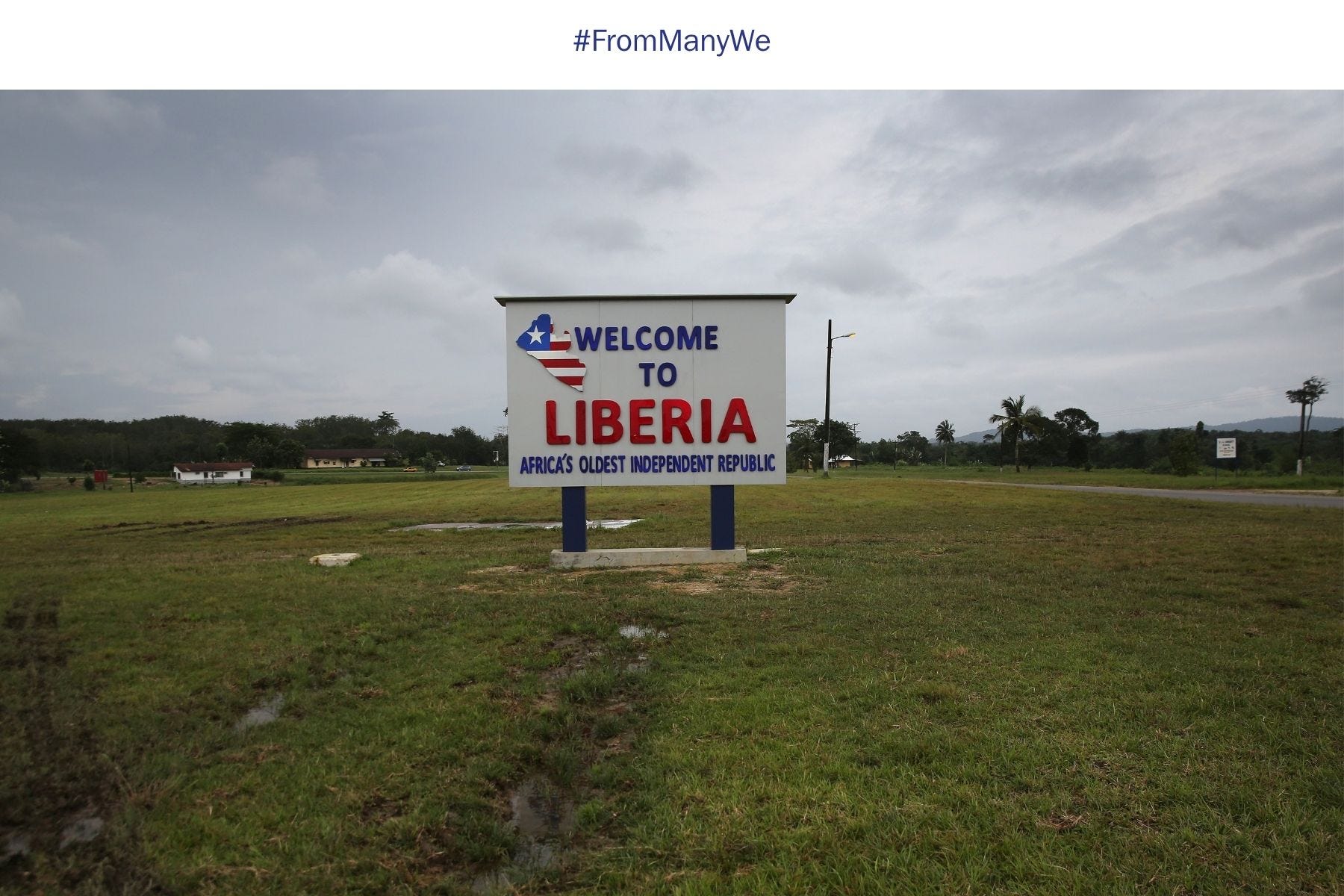
Peyton Skipwith hated Liberia. Within the first six months of his arrival in 1834, he had lost his wife and daughter to fever—probably malaria. He was a skilled stonemason, but work was hard to find, and food and other essential goods were expensive. He was “dissatisfied in this place,” complaining, “The sun is so hot that people from America cannot stand it.” The United States of America was the only country he had ever known. But it had rejected him, exiling him on an unfamiliar continent.
This year, another man expelled from the United States to Liberia felt similar despair. He missed his wife and children, 5,000 miles away in New Orleans. “I wondered what had happened to the US that I used to know,” he said. “A country where I felt free and safe to live and go out with my children.” The US wasn’t the only country he’d known; he had fled persecution in Honduras, the country of his birth. But he’d lived and worked and built a family in America. Liberia wasn’t home.
With nearly two centuries between them, each of these men had been exiled to the same unfamiliar spot on the West African coast—in both cases, because the country that had welcomed their labor could not imagine a place for them among its citizenry. Both were victims of attempts to define American identity in racial terms. But these stories also demonstrate the immorality and impossibility of making the United States into an ethnostate.
The American Colonization Society: An “Anti-Slavery” Plan for Global Segregation
Most Americans today know our country’s shameful history of slavery and justly celebrate the abolitionist movement. But fewer know about the African colonization scheme, which had greater support and influence in the decades before the Civil War than the more radical call for immediate abolition. Nominally, the African colonization movement promised to remove all Black people from the United States, which also meant ending slavery was an eventual goal but never an immediate threat. Between 1822 and 1860, the White-led American Colonization Society deposited more than 10,000 Black Americans in Liberia. Emigration was theoretically voluntary, but choices cannot be free in the context of racial oppression. Enslaved people who were emancipated for the voyage (including Peyton Skipwith) usually had to choose between American slavery or Liberian freedom.
Liberian colonization was a disaster from the beginning. Disease was devastating. One modern demographer says Americo-Liberian colonists experienced “the highest mortality ever reliably recorded.” The US government provided significant financial support, but the Liberian colony was primarily backed by private donations from White Americans, and funding was always insufficient. Settlers from the United States perceived the region’s indigenous population as culturally and religiously undeveloped and established exploitative economic relationships that often mirrored American slavery.
Liberia’s troubled foundation haunted its later history. Its precarious economy led the desperate Liberian government to sign an unfavorable 1926 deal with American industrialist Harvey Firestone, creating a massive rubber plantation that often used forced labor. In 1989, tensions between the descendants of Americo-Liberian colonists and other ethnic groups contributed to a lengthy and vicious civil war. Children were conscripted to fight. At least eight percent of Liberia’s total population was killed.
In the 19th century, the American Colonization Society openly advocated for a racially segregated planet. As one supporter argued, “The black skin, the curled hair and the flat nose will be held in contempt and disgust by the white man, and felt as the cause of his degradation by the negro . . . and hence, the absolute necessity of their separation from us.”
Third Country Deportation and the New Ethnonationalism
Trump’s rhetoric is not quite so explicitly segregationist. But he has referred to nations where people of color make up the majority of the population as “shithole countries” and has expressed a preference for immigration from White-majority countries. He’s claimed that immigrants are “poisoning the blood” of the United States, has spread xenophobic conspiracy theories, and has dehumanized undocumented immigrants as “animals.”
His administration’s policies followed suit. The White House has substantially curtailed legal immigration, ramped up deportations, and boasted about encouraging “self-deportation.” It ended the humanitarian Temporary Protected Status program for immigrants from thirteen countries. It has frozen all asylum and refugee immigration cases, with the sole exemption of White Afrikaners from South Africa. In effect, the only people that the Trump administration treats as worthy of refuge in the United States are White people fleeing from claimed racial persecution in Africa. Many courts have found that these policies violated rights of due process, free speech, and habeus corpus.
Since 2025, the White House has deported immigrants to “third countries” when they cannot be returned to their country of origin, either because that country refuses to accept them or because American courts have ruled that they face threats of persecution there. More than thirty nations, including Liberia, have accepted at least 25,000 deportees, usually in exchange for money. (For Liberia and other impoverished countries, these agreements were a way of at least partially restoring the humanitarian assistance they’d previously received from USAID, before Trump shuttered the agency.) Third country deportation—briefly blocked by a federal judge but permitted to continue by the Supreme Court—is how the Honduran man described above found himself on the Liberian coast, an ocean away from anywhere he’d ever known.
Trump’s rhetoric, like the arguments for Liberian colonization two centuries ago, draws on a long tradition of defining American identity through race and ethnicity. Trump and his allies have cited far right ideas like “replacement theory” and “heritage Americans,” which elevate White Americans as emblematic citizens, at risk of displacement by people of color, who are portrayed as having weaker claims on American identity. Put simply, this is White nationalism.
An Inclusive Vision for Democracy
But this has never been the only vision for our country. The Liberian colonization plan failed in part because many Americans, including the vast majority of Black Americans, rejected the idea of a racially segregated planet. Civil rights activists like Frederick Douglass articulated an alternative vision of the United States as a multiracial democracy: “We address you not as aliens nor as exiles, humbly asking to be permitted to dwell among you in peace; but we address you as American citizens asserting their rights on their own native soil.”
The American Colonization Society ultimately failed for the same reason attempts to homogenize the United States through deportation will fail today: engineering national demographics through expulsion is practically impossible. After decades of organizing, fundraising, and lobbying, the colonization movement had made no impact on the country’s racial makeup before the Civil War ended slavery and the Reconstruction amendments guaranteed Black Americans’ citizenship rights. Enshrining equal citizenship in the Constitution wasn’t enough to end White supremacy and racial segregation. By the early 20th century, there was another Liberian colonization movement, this time led by Black Americans seeking to escape oppression.
Today, the United States is a diverse and diversifying nation. The next generation will have no single racial majority; less than half of American children today are non-Hispanic Whites. Even the Trump administration’s unrealized goal of deporting one million people per year can’t disrupt these demographic trends.
Liberian colonization failed, and the United States spent the next century trying to solve “the Negro problem” through oppression and segregation. America is, and always will be, diverse. The only question is whether we will be inclusive.
Alex Lovit is a senior program officer and historian at the Kettering Foundation. He is the host and executive producer of the Kettering Foundation podcast The Context.
From Many, We is a Charles F. Kettering Foundation blog series that highlights the insights of thought leaders dedicated to the idea of inclusive democracy. Queries may be directed to fmw@kettering.org.
The views and opinions expressed by contributors to our digital communications are made independent of their affiliation with the Charles F. Kettering Foundation and without the foundation’s warranty of accuracy, authenticity, or completeness. Such statements do not reflect the views and opinions of the foundation which hereby disclaims liability to any party for direct, indirect, implied, punitive, special, incidental, or other consequential damages that may arise in connection with statements made by a contributor during their association with the foundation or independently.