

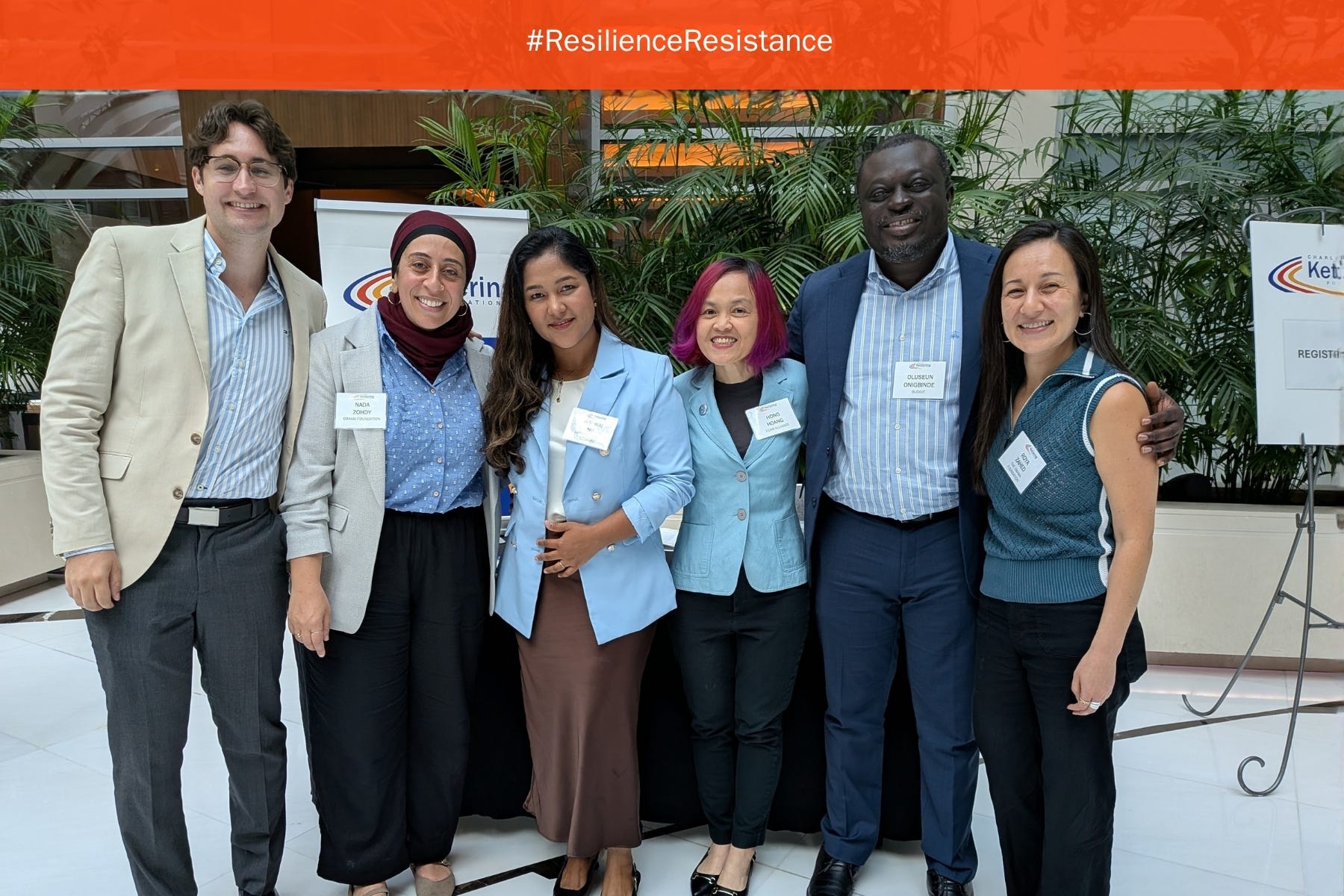
In late July 2026, the Kettering Foundation hosted Solidarity across Borders: Meeting the Moment in Washington, DC. This two-day event began with panel discussions and keynote remarks in a plenary setting. The second day featured discussion and presentations for a smaller group of foundation partners, such as the Obama Foundation. Watch a short video of the first day’s convening.
How have people found the courage to lead by example and persevere through difficult times? Partnering with the Kettering Foundation during its Solidarity across Borders: Meeting the Moment event in Washington, DC, the Obama Foundation hosted a panel spotlighting three Obama Leadership Network members from different countries but with common values. Their stories of resilience spoke to the power of principled and persistent leadership and collective solidarity.
Obama Scholars Hong Hoang from Vietnam, Wai Wai Nu from Myanmar, and Oluseun Onigbinde from Nigeria, shared their distinct yet parallel experiences. Because of their work to promote open civic space, combat marginalization of minority communities, and shine light on corruption, each of these individuals respectively faced personal consequences yet each of them persisted.
Their reflections highlight the agency within us all. Leadership is not practiced by simply having certain titles, power, or authority. Leadership is not practiced by appearing to be the bravest or the loudest person in the room. Leadership is a continual choice each of us can make to act on our values and help others to do the same—even, and especially, when it is difficult.
Hoang, Nu, and Onigbinde offered three powerful leadership lessons.
Lesson 1: Resilient Leaders Give People Opportunities to Act on What They Care About
Oluseun Onigbinde’s unlikely leadership story began when he worked as a banker in Nigeria. He believed the public had the right to better understand how the government was spending taxpayer money. During a hackathon in 2011, he cofounded BudgIT to leverage new technologies to help simplify and disseminate public budget information to everyday Nigerians. Since then, their work has reached more than 20 million citizens in Nigeria and beyond.
One day, Onigbinde got a frantic call from the mother of one of his employees who had disappeared. The BudgIT team learned that their colleague had been arrested on trumped up charges relating to his work with the organization. Family and friends were not told where he was being held. Onigbinde and team leaped into action and contacted friends in the media to spotlight the case. The broadcast asked viewers to share information that might help locate their missing colleague.
Onigbinde found strength in recognizing that his team’s work had many silent supporters. By asking for help, he gave those people a concrete opportunity to take action in a moment of crisis and help spread the word about the detained colleague. This public pressure helped grant his colleague’s release and reunited him with his family. When recounting the episode, Onigbinde noted, “When transparent information makes the powerful uncomfortable, then we are living in dangerous times.” Hoang echoed this experience as it related to her efforts as a environmental activist: “Climate action, education, public health, or human rights all depend on the same thing: whether people can organize freely, participate, and ask difficult questions without fear.”
Lesson 2: Resilient Leaders Cultivate Inner Strength to Combat Chronic Exhaustion
The daughter of a Rohingya rights activist in Myanmar, Wai Wai Nu found herself following in her father’s footsteps. After her father became a prominent opposition politician, he was targeted and imprisoned along with Nu and other family members in 2005. Nu spent seven years in prison and sees that chapter as an important part of her life education. When reflecting on her experience, she stated, “You don’t have to be an activist [yourself] to be jailed under authoritarianism.”
Despite this hardship, Nu decided to become an activist herself once she was released. She began working to build bridges between young people in Myanmar across diverse communities, even as the Rohingya continued to be persecuted. She has worked as a peacebuilder for the last several years, founding both the Women’s Peace Network (WPN) and the Yangon Youth Center. Nu is now raising her family in the US, living in exile while working to support the next generation of peacebuilders. Her resilience has been fueled by the momentum that comes from choosing to take action, even when circumstances are difficult. “If we don’t act, who will?” She uses tools like social media to keep causes like her own alive.
Hoang agreed on the importance of continuing to act rather than succumbing to chronic exhaustion: “When people are worn down by constant pressure, they quietly stop showing up, and that’s often when things can really start to slip.” If those who are working to address societal challenges are chronically fatigued or lose belief that their actions make a difference, the challenges will continue to grow.
Lesson 3: Resilient Leaders Foster Relationships of Solidarity and Refuse to Be Isolated
Like Nu, Hong Hoang also spoke about the challenge of rebuilding her life in exile. She was a prominent public figure at the helm of Vietnam’s environmental movement when she and several colleagues were targeted for their activism and imprisoned on false tax evasion charges in 2023. After the global #FreeHong #FreeThemAll campaign engaged thousands of supporters across dozens of countries, Hong and some of her other colleagues were released in 2024. Now, she is building a new body of work through Echo Alliance, a new nonprofit that supports cross-border, cross-issue networks of solidarity.
For Hoang, resilience came primarily from knowing she was not alone. After experiencing four months of isolation in prison, she described the surge of strength when her husband was finally allowed to visit her and told her about the “countless people out there who are fighting for you.” Hoang reflected on how isolated leaders become easier for their opponents to sideline or diminish; whereas knowing you are not alone provides grounded hope in the face of hardship.
All three of these leaders agreed that forging solidarity across movements and across countries can be more challenging than doing so at the interpersonal level. Building strategic networks, rooted in common values and genuine friendships, can be an underestimated resource in struggles to protect and deepen democracy. The conversation lifted up the fact that networks are a key middle level between individual and institutional solidarity. Solidarity is a strategy that requires building and tending to meaningful, mutually beneficial cross-border relationships, long before the need to activate them.
Courage Is Contagious
The panel discussion concluded with two reminders:
We all have the opportunity to practice leadership, no matter the circumstances we are in.
Courage is contagious.
Well-connected networks can be a powerful antidote to the moral exhaustion that many leaders face today in light of growing challenges to democracy and human rights. Long-term social change requires not only smart strategies but also strong networks of support and individual leaders with strong hearts. Inevitably, hearing stories of resilience can inspire all of us to find and deepen our own internal sources of motivation and courage.
Nada Zohdyvis global network lead at the Obama Foundation, connecting nearly 1,900 Obama Foundation leadership programs alumni across 160+ countries to foster meaningful relationships and collaborate across issues and borders. She has 15 years experience in democracy and network-building.
Resilience & Resistance is a Charles F. Kettering Foundation blog series that features the insights of thought leaders and practitioners who are working to expand and support inclusive democracies around the globe. Direct any queries to globalteam@kettering.org.
The views and opinions expressed by contributors to our digital communications are made independent of their affiliation with the Charles F. Kettering Foundation and without the foundation’s warranty of accuracy, authenticity, or completeness. Such statements do not reflect the views and opinions of the foundation which hereby disclaims liability to any party for direct, indirect, implied, punitive, special, incidental, or other consequential damages that may arise in connection with statements made by a contributor during their association with the foundation or independently.