

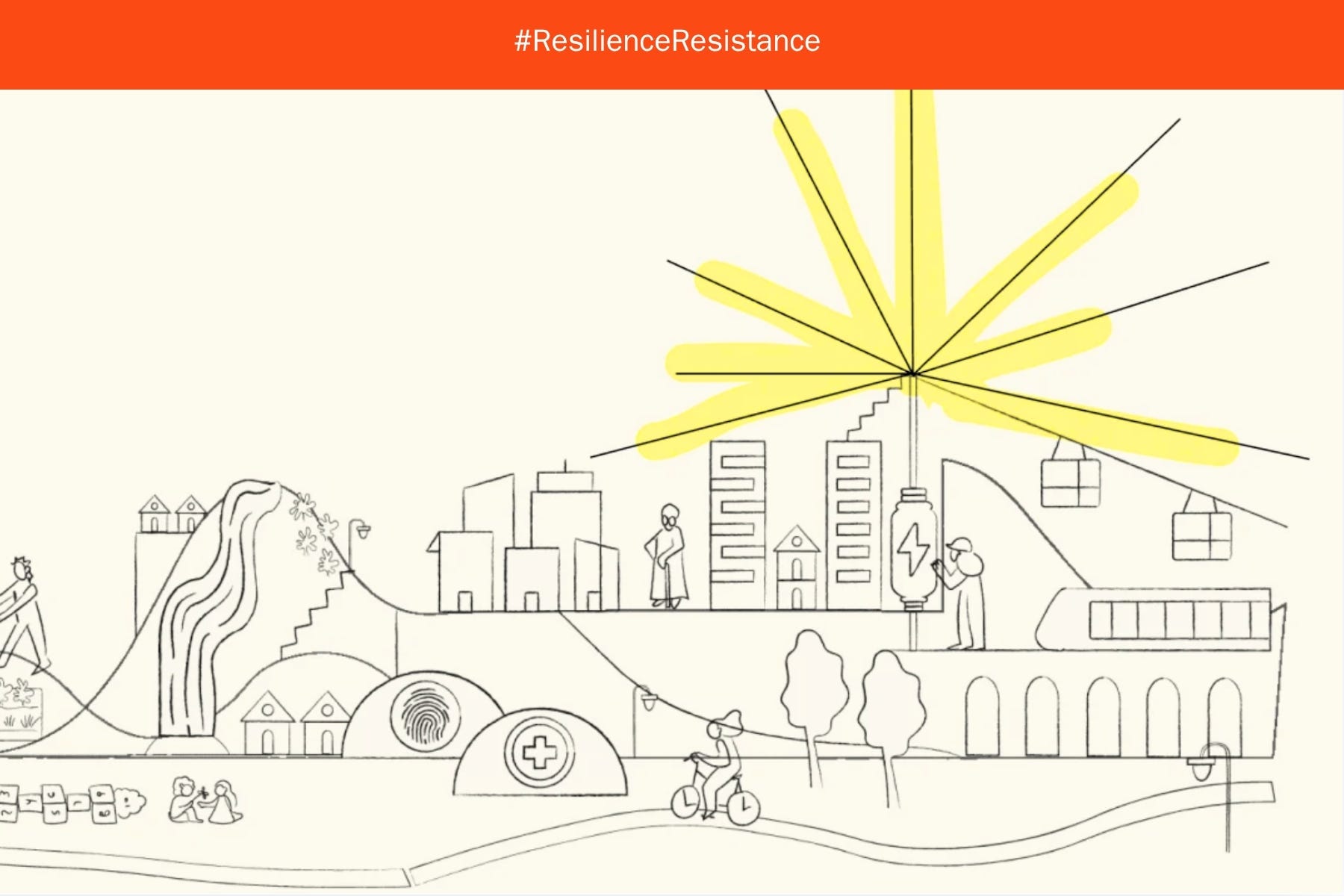
Trust in democracy is fragile across the globe, and Latin America is no exception. Citizens are frustrated with governments that fail to solve the problems that matter the most to them. People still vote, but as economic instability, corruption, and insecurity dominate daily life, the value of democracy has faded, leaving it perceived as an abstraction and disconnected from real problems.
At the Local Level, Another Story Is Unfolding
In cities and towns across Latin America, local governments and communities are rebuilding trust through participation that feels tangible, useful, and close to people’s daily lives. Far from grand ideological projects, local governments are making practical efforts to solve concrete challenges, such as public safety, waste management, and social cohesion, by bringing citizens back into public life.
The lessons emerging from these experiences are encouraging: democracy can regain legitimacy when it delivers, and delivery improves when participation is channeled effectively.
The Power of the Local Scale
Local governments operate where daily life actually happens. People can see the impact of effective (or ineffective) management in the opportunities they have to thrive: how smooth is their commute, whether reliable care is accessible for their loved ones, and how easy (or frustrating) it is to navigate local bureaucracy. In the effort to restore democracy’s social value, local scale can be both a unique advantage and a liability. If local governments don’t deliver, trust in institutions is eroded, and with it, the very meaning of choosing and participating in democracy. But if those governments are able to lead transformation toward a better way of life, that trust can be rebuilt.
At Red de Innovación Local (RIL), a nonprofit organization that connects and empowers 1,000 local governments across the Global South, we work alongside local practitioners to encourage a comprehensive approach to local governance that involves the private sector, academia, civil society, and citizens in an effort to understand challenges and deliver solutions.
The local administrations that are most successful in tackling their ocal challenges teach us that when governments position themselves as facilitators and enablers rather than merely top-down executors, they achieve more impactful outcomes. This also applies to citizen participation; cities can choose to use symbolic consultations that legitimize action or to integrate citizens into problem-solving and harness their power for long-lasting systemic change.
Trust is a catalyst for local delivery, so a government that can orchestrate collaboration to rebuild it is, in our view, on the track to success.
To illustrate how this is possible here is the story of San Miguel, in the Province of Buenos Aires, Argentina, and how they improved delivery by rebuilding trust, when many governments might have looked for reasons to turn their backs on democratic practices.
Tackling Insecurity Through Participation
Personal safety is one of the main sources of social dissatisfaction in Argentina. According to the latest results of the Survey on Political Satisfaction and Public Opinion published in May 2026 by the Public Opinion Observatory of Universidad de San Andrés, it is one of the leading public challenges, with 26% of surveyed citizens acknowledging it as one of the main problems of the country, equal to poverty and trailing closely behind low wages, unemployment, and political corruption.
Insecurity fears are not new. In 2016, San Miguel’s government, despite having security cameras and patrol vehicles, struggled to make its citizens feel safe. After trying different approaches, they turned to the community and devised Ojos en Alerta (that loosely translate to “Stay Alert”), an initiative where neighbors become active partners in local security. People are trained to report safety concerns and emergencies using WhatsApp. This simple connection created faster information flows and improved crime prevention, allowing city departments to act based on real-time data.
Through these public trainings and workshops, the government built trust with groups that had previously seen little point in sharing information with authorities. After 10 years, the results are concrete: citizen-led reports and preventive alerts increased by 620%, while reportable crime dropped between 50% and 85%. Monthly messages went from 400 to more than 3,600. Nearly 50% of San Miguel residents use the tool regularly.
Today, this initiative has scaled to more than 100 cities across Argentina, and its success demonstrates that citizen participation can be both a core democratic value in itself and a highly effective catalyst for effective problem-solving.
Shifting from What to How
San Miguel’s replication success also shows us that in an era of artificial intelligence, where technical answers (“the what”) are increasingly commodified and readily available, the true bottleneck of public policy lies in the human and behavioral dimensions of implementation (“the how”).
How can cities overcome this bottleneck? Organizations, including RIL, offer tools, methodology, and structure to harness participatory processes and unlock impact. While we don’t need to reinvent the wheel, we do need the political will to tackle the root causes of problems, involve the right actors, and make decisions based on evidence.
Collective Action as Key to Scale Success
Are local governments the key to countering global democratic backsliding? Are mayors the actors we need to unlock this latent power of renewal and transformation? Our work with more than 1,000 cities across the globe gives us reason to be optimistic that they are.
Yet, isolated local success stories won’t do the trick. If transformative participatory solutions are to spread, cities must learn from one another, share methodologies, and build collective narratives. This is where city networks and collaborative organizations play a crucial role, transforming individual experiments into a broader movement capable of reshaping the culture of governance.
When local leaders choose to govern with people rather than for them, results follow. But building that trust and sustaining it over time is challenging. Channeling participation toward meaningful impact requires political will, methodology, and the humility to put citizens’ voices at the center of the work even when it is inconvenient. At RIL, this is precisely our commitment: to work alongside local government teams across the region, ensuring that collaborative, high-impact solutions become the norm, not the exception.
Inés Reineke is global director of innovation at Red de Innovación Local (RIL), leading a team focused on detecting and replicating government innovation across the Global South.
Resilience & Resistance is a Charles F. Kettering Foundation blog series that features the insights of thought leaders and practitioners who are working to expand and support inclusive democracies around the globe. Direct any queries to globalteam@kettering.org.
The views and opinions expressed by contributors to our digital communications are made independent of their affiliation with the Charles F. Kettering Foundation and without the foundation’s warranty of accuracy, authenticity, or completeness. Such statements do not reflect the views and opinions of the foundation which hereby disclaims liability to any party for direct, indirect, implied, punitive, special, incidental, or other consequential damages that may arise in connection with statements made by a contributor during their association with the foundation or independently.