

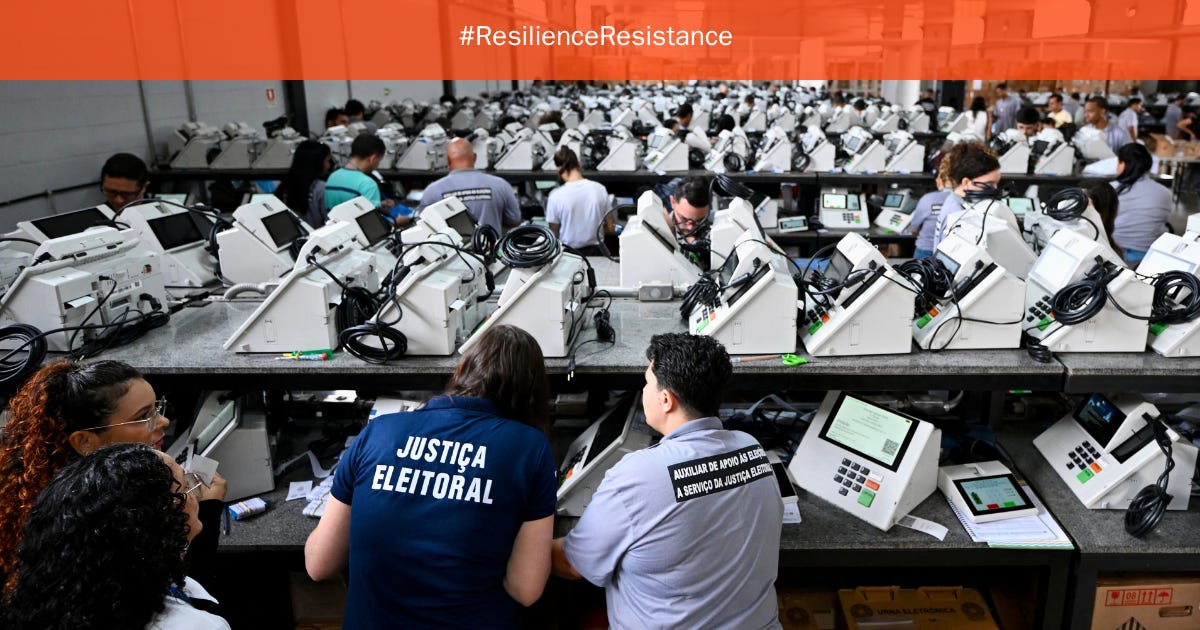
In October and November 2026, Brazil and the United States will mobilize millions of voters for general elections that can determine what the future of these countries will look like. The US midterm elections and the Brazilian presidential elections have more than their high stakes in common: both have been facing unprecedented actions by the US federal administration. These aggressions are not only causing distrust in both countries’ electoral systems but also breaking down the trust in democratic institutions as a whole.
The election meddling efforts of the Trump administration have shifted from speculation to proven reality. The US has witnessed a wave of attacks on its own electoral system and against voting rights, ranging from false accusations of fraud in the 2020 elections, to attacks on mail-in ballot processing, state redistricting wars, and unorthodox attempts to gather voter data at the federal level. These attacks are decentralized and coordinated, and the undemocratic behavior has been largely documented by the press and by pro-democracy movements across the country.
Brazil, in turn, has been targeted by the US government with a combination of political, economic, and diplomatic measures that harm the country’s economy, its institutions, and the public debate. Prominent examples include tariffs on Brazilian goods ranging from 25% to 50%, despite the US holding a trade surplus with Brazil, and the use of sanctions against Brazilian authorities, including the Brazilian ambassador to the US whose diplomatic visa was revoked with no justification. These politically motivated actions end up causing turmoil in the country’s political landscape and influencing polling numbers.
But the main goal of President Trump’s agenda is not simply to favor a specific candidate or political party but rather to influence how US and Brazilian people perceive their institutions. This authoritarian tactic has a simple method: normalize anti-democratic rhetoric and action through widespread attacks on institutions and contaminate public opinion by combining disinformation with social media strategies fueled by AI-generated content. Eventually, the content of an attack doesn’t even matter, as perpetrators only need the emotions that these narratives provoke in those who rely on social media as their primary source of information.
A Global Challenge
Neither Brazil nor the United States are isolated pieces in this scenario. The 21st century has brought a global wave of autocratization, in which elected leaders use formal mechanisms to erode checks and balances and weaken the institutions that sustain democracies. The most recent V-Dem report, a respected tool that measures the state of democracy in the world, indicates that we have returned to the democratic levels of the 1970s. This means three out of four people in the world are living under authoritarian regimes. The report also finds that there is currently a record high of 44 countries undergoing autocratization, including the United States. These are not encouraging numbers and ought to serve as a warning. Living under a democracy is not a given reality; it requires continuous commitment.
This does not mean our institutions are immune to criticism or that electoral processes cannot be improved. What the public has been observing, however, is a debate driven by untruthful narratives that are shaped by authoritarian interests. There is a huge gap between the existing pseudo-debate and true democratic discussion, which is guided by evidence, transparency, and tolerance for dissent, and is free from illegitimate interference. President Trump’s coordinated strategy to undermine US and Brazilian democracies crosses a line and endangers our right to self-determination.
Democracy is not a static arrangement, but rather a dynamic construction that requires the daily commitment of each and every one of us. Rejecting all forms of election meddling and attacks against our hard-won democracies is a collective pledge that Americans and Brazilians must embrace. It is the only way to ensure the will of the people as the sole guide to the future of our nations.
Sami Sternberg is the International Affairs Coordinator of Pacto pela Democracia. He holds a master’s degree in international affairs from Columbia University.
Resilience & Resistance is a Charles F. Kettering Foundation blog series that features the insights of thought leaders and practitioners who are working to expand and support inclusive democracies around the globe. Direct any queries to globalteam@kettering.org.
The views and opinions expressed by contributors to our digital communications are made independent of their affiliation with the Charles F. Kettering Foundation and without the foundation’s warranty of accuracy, authenticity, or completeness. Such statements do not reflect the views and opinions of the foundation which hereby disclaims liability to any party for direct, indirect, implied, punitive, special, incidental, or other consequential damages that may arise in connection with statements made by a contributor during their association with the foundation or independently.